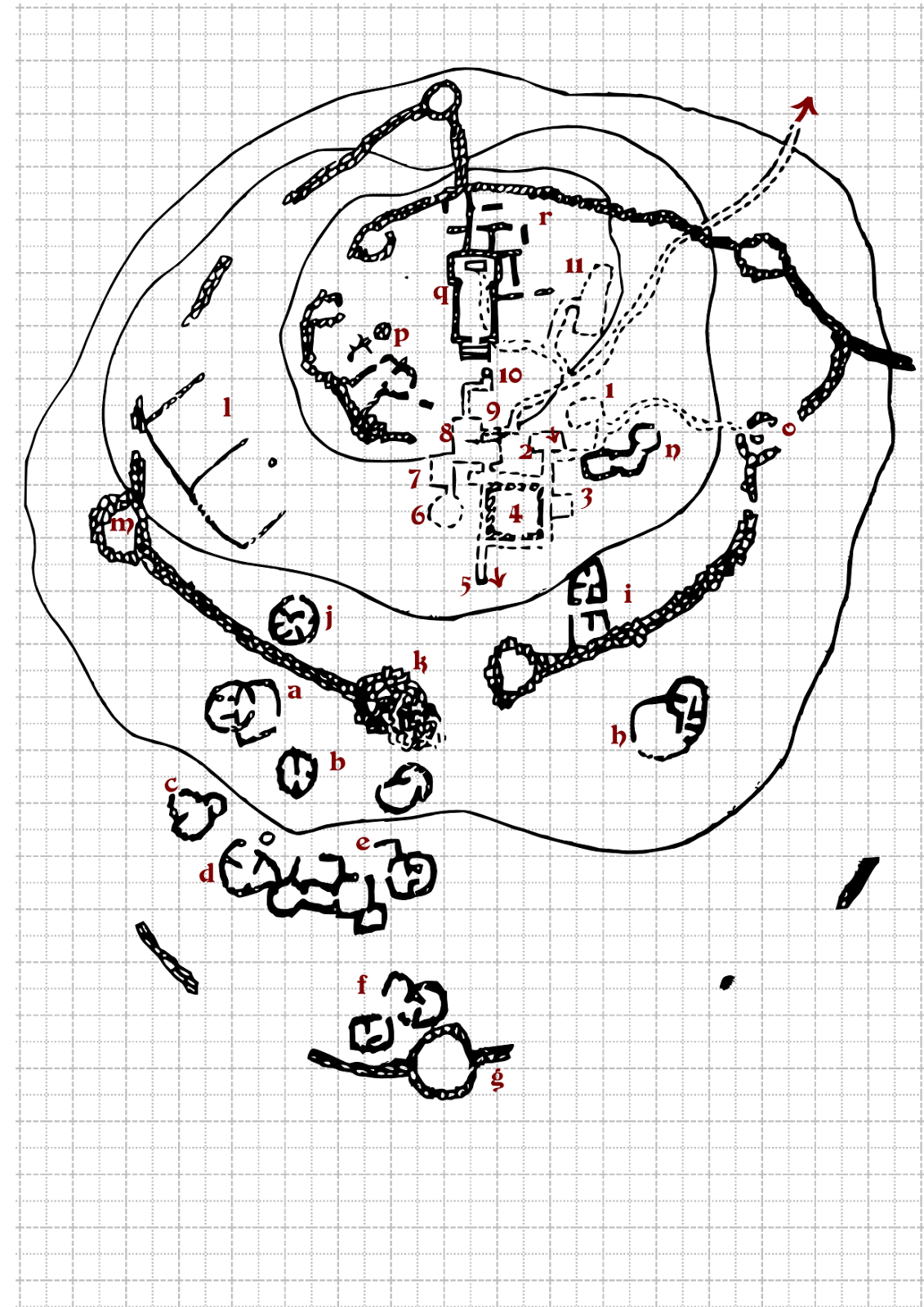
A map of the area; one field equals six metres. Dashed areas below ground. Click to enlarge.
This post details one location found in the setting of Gog, Part 1 describes the history and the current inhabitants of the outside area of a ruin; the next parts will delve deeper.
Adventurers may turn this run-down “colony” into a base of operations; they may rebuild the citadel with help of the locals and take control over the area. In that case they would eventually become tributaries to Gog – or face retributions. They may also come here to collect bounties on the residents, or find bloody work on the local thieves’ behalf.
Here follows a description of the inhabited areas of the rubble. Buildings a to h are part of the nameless settlement. Unless mentioned otherwise all buildings consist of reddish, roughly hewn rocks and possess floors of clay mixed with grasses. Roof are normally made from bount reeds and wood held in position by clay. The general inventory as well as room layouts is up to the reader’s imagination.
a) Juthul the Archer. A yellow-skinned Ulak man, who left behind the life of a herdsman and troubled the plains for a while as a bandit of some reknown. The inofficial leader of the local scum. Rules-wise, he is an ageing warrior who gets a big bonus to all attacks with bows or thrown daggers due to his eagle eyes. He is rather supple, with sun-dried wrinkly skin the colour of saffron and a long white beard. He wears an armour of hareded layers of linen with a coating of snake leather, the scales of which being of peculiar size. He has final word on whether strangers are accepted in as guests or robbed as enemies. Juthul lives in the uppermost of the inhabited houses, which is protected by a non-inflammable roof made of clay, supported by strong wooden beams on the inside of the house. Livestock is kept in his yard, where there is a fireplace. The house has an antechamber, a sleeping chamber, a common room for visitors with once-valuable futons and rugs as well as storage room with a humble collection of fine clothing and his collection of weapons. The most prized possession in their is a carefully knitted rug depicting an Ullaki woman and a child. Juthul does not tolerate questions regarding the rug or the depicted. He was once patriarch of a sizable family clan, but lost all relatives in a bloody feud with a bigger tribe resulting from his pride.
Juthul is surprisingly old, his strength diminishing, but as a foe he is not to be taken lightly, possessing an iron will, experience in battle, loyalty for his men and a stern conviction to defend what is his.
b) Gruula the Terrible. A yellow Ullak man, fugitive slave from the quarry town of Qutta, who first cut his master’s throat and then proceeded to murder his captor’s whole family. For two years he roamed the hills of Qutta as a cattle thief and petty robber before meeting Juthul. He has been working alongside him for eight years, seeing in him a sort of heroic father figure he is willing to protect with his life.
Gruula looks harmless, but he is an experienced cutthroat and in battle is filled with near-demonic frenzy. The other men fear him for his ferocity and his swings of temper. Gruula often talks to himself. For these and other reasons he lives in a house of his own instead of with the other men.
The walls to east of Gruula’s house stand only about as high as benches. They serve as the community’s meeting place.
c) Drushayanti, the Gubi woman. Blue-skinned, almost two metres tall, with mighty tusks with silver-filled carvings. Exceedingly strong and able to grant minor magical blessings. Seven years ago, her village in the great Rift was raided by slavers from the deep lands led by a male Gubi from a rival tribe; the prisoners were sold to all corners of the world. She sided with Juthul three summers past when he robbed a caravan where she had to work as burden-slave. Her training to become village shaman was never finished.
Drushayanti is smarter than she looks, working as a sort of logistician to the bandits organizing the gang’s equipment, provisions and supplies. She often takes over for Juthul when it comes to trade with friendly travellers, selling or bartering goods.
d) The great common housing. The western building serves entertainment, with beer kegs, tables, dice and whatever else belongs into a make-shift “inn”. Visitors of the settlement will be met here and catered for. In the eastern building live twelve men, including fugitive Magog triplets who had deserted from the army. The men are loud, obnoxious, violent and looking for quickprofit.
e) Glmuth the Cook, “Father of the Stable”. A fat Ullak with sickly skin responsible for the preparation of the meals in the common building d). In fact an astonishingly capable fighter who had served with Juthul long enough to possess certain privileges like a house of his own. Sometimes dares criticise Juthul, but surprisingly still possesses two ears. He misses two fingers, but for unrelated reasons. Glumith smells horribly, which might be due to him sleeping just one wall away from the camels and riding donkeys. Very agile for a man of his shape.
f) Dumuq-Ishkur, sagely healer from Gog. Nobody really knows why he’s here. In any case, he’s been caring for the wounded from Juthul’s gang for years. He keeps a few goats in the tower ruins. Next to his work as healer he is also the village’s butcher. Dumuq-Ishkur is not a man of violence and will run if battle erupts in the settlement. He owes a great debt to Juthul – some think he holds a share of responsibility for the feud that destroyed the old Ullak’s family. Others claim he found the dying Juthul, pieced him back together and thus robbed him of the possibility to die with honour with his family. Juthul trusts him.
g) Ruins of the outer tower. The circular walls are man-high and protected from the sun by tall grasses. The floor itself is about one step lower than outside. Entrance is possible via a bow-shaped hole in the wall and a small ramp between the buildings in f). The tower serves as a goat stable and, if necessary, a prison for captives. Shackles and chains are fastened to the wall. A half meter below the well-stomped clay and goat dung a lucky character may find an ancient silver ring bearing strange symbols. The ring emits faint magic (visible through the earth for those in possession of the gift) and protects its wearer from spells of control and influence. The plain-looking trinket was a gift from an enarmoured Juggool witcher to the secret man of his heart, an officer who died defending this very tower against the army of Gog. The ring was supposed to always remind him of the importance of true feelings.
Each day the ring is worn there is a 1 in 2 chance that, an hour after the sun’s highest position, a man will be heard weeping for a few moments. Should the wearer become alerted of this he may concentrate and hear the weeping every day. This may come in handy as a rough measurement of time if below ground and without the sun to tell days apart.
Furthermore, each day there is a 1 in 100 chance that the translucent ghost of the witcher Houlagal, in a fine blue scale-like garment, is awakened. He will attack every Magog (or, for the matter, every Homo Sapiens Sapiens) in the group with relentless hate. Should there be a male Njema in the group the witcher will see in him his former lover reincarnate (the truth of this sentiment is up to the game master). He speaks Juggool (which might be similar to the tongue of some Njema tribes) and very broken antiquated Magog, works magic like a moderately advanced magician or sorcerer and otherwise works like ghosts in the used system. He knows the secret of the creation of the firelances, but will only share it if convinced to have found his former lover or if the group will use it to fight against the resented empire of Gog. Being bound to a ring that protects against charms and enfeeblement, the ghost is hard to deceive and completely immune to mind control.
h) Here the foundations of a very large building with a big yard reach from earth and thorny bushes. Nobody talks about why it is not being used. At least everybody says nobody talks about it. In fact everybody will have their own story – there are claims of a ghost haunting the ruin, of poisonous scorpions, of Juthul having bad dreams about it or that once a corpse was found in there.