Moth

And another night spent people-spotting on a dating site, getting glimpses into lives that will never intertwine with mine. So many beautiful people all over the world, so many stories, so many wounded or searching or brightly shining souls out of my reach. I have never before felt so removed, like a shadow of a man desperately reaching for the light, only to vanish once exposed to his desire.

I want to connect, I want to help, I want to watch somebody grow and grow in turn. But I will not trust, not any time soon. Not in others, not in myself, not in fate or luck or whatever you want to call it.

The sheer banality of my loneliness, of being left alone, defies description. How can one expect to remain in love without the biological basics, like a minimum of contact? Of course feelings will vanish this way. There is no mystery about it, and there is no fixing it in one’s head. One must fix it on the physical level. Why did she not see it? Speaking of her love one day, not a full day later to disengage for a lack thereof.It is funny, really, and breaks my heart in a million pieces. Yet I am sure somebody will take offense at my complaining and twist the knife a bit, for a man must not complain, ever, and a man must not be sad or hurt or cry or feel betrayed.

Who would even listen to this?

The Citadel of Jogovar: Upper Ruins (pt2)

The second part of the module, following the description of the lower ruins, settlement and background of the ancient Juggooli citadel of Jogovar.
The whole inner perimeter of the fortress ruin, gaining height towards the center, is covered by reddish sandstone rubble, broken clay bricks and thorn bushes; sand is filling the crevices. A few corroded and twisted metal pieces lay spread among the debris.

JhoghovahrAußenBeschriftet

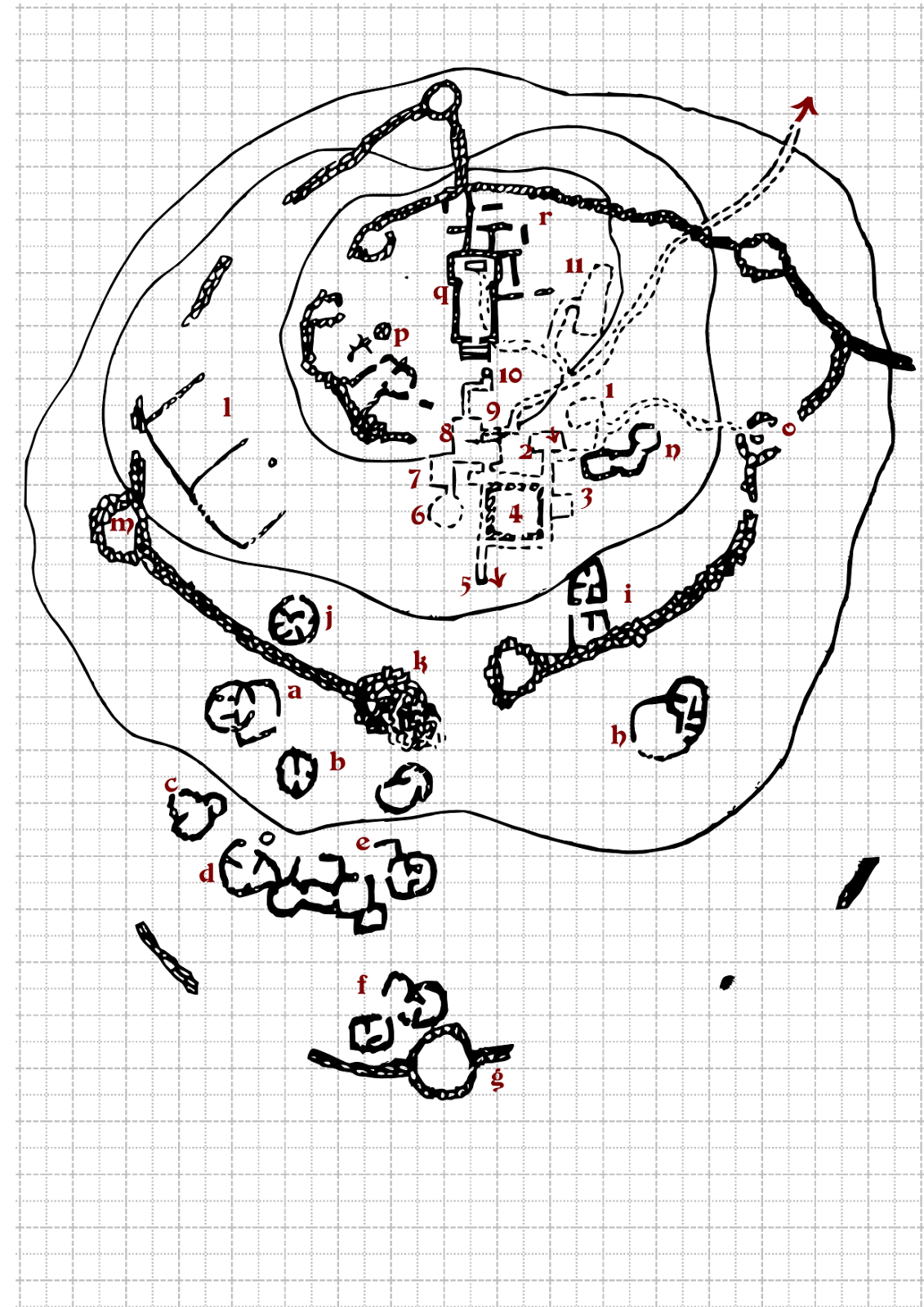
A map of the area; one field equals six metres. Dashed areas below ground. Click to enlarge.

u) Two seemingly well-preserved buildings. The northern one is built directly into the incline of the mound. The domed ceiling is still present, but at threat of collapsing. If there are strong vibrations or if heavy ground work is performed (like digging for treasures, moving stones) saving throws or whatever is appropriate in your system may be necessary to prevent being crushed by falling stones. The building has been looted long ago.

j) The ruined walls of this domestic building hold nothing special.A little digging through the rammed clay floor reveals a thick corked ceramic vessel, containing the well-preserved skeleton of an infant. The vessel is covered in glowing imperishable writing. In the dead tongue of Juggool the makers plead for acceptance of the stillborn child into the arms of a Great Mother Goo-Lehe where it may speak well on behalf of the living. Together with the skeleton some pearls and a small but valuable ruby are buried in the vase.

k) Completely destroyed tower ruin that serves as a quarry for the settlers. Among the rubble there is a knife of polished flint with a grip of blue metal, apparently cast around it.  It does double damage against Arraqu and all reptiles. It was created by the Juggooli as a weapon against the Lords of the Glass Lands, an empire still existing to this day. As they are of the same species as the local Arraqu people of today, the knife holds equal power against them. Should the knife be carried into the Glass Lands and its origin revealed there will be grave repercussions for the user.
A poisonous snake, moderately dangerous, made its nest in the ruin and dislikes disturbances.

l) Large, but barely recognizable angular foundations and a well. Maybe used as small gardens or orchards for the citadel’s occupants? Perhaps a former corral? Or something else entirely?

m) Almost completely preserved tower ruin. Still high enough (say, 14 metres) to allow overseeing the surrounding terrain for many miles. Access via the inside of the mural ring through an archway. A stone stairwell leads to the tower ceiling that is often used by Juthul (see building a ) as a viewing platform – both to look out for invaders and to find solitude in disheartened bird watching. In fact, an air of melancholy and despair befalls all characters who linger around this building – an echo of the ancient siege. The place is exceedingly well suited for the summoning of ghosts and for other breeches relating to time or the transition between states of existence.

n) Around a small ring of stones – once a makeshift fireplace – lay the gnawed and de-marrowed bones of three humans. Going by their shape, sage of anatomy may identify them as former Magog, Ullaki or Arraqu people. If specifically inquiring about the shape of the skull the Arraqu may be ruled out. Cause of death in the corpses is not obvious, but one of them misses the left forearm.
Nearby are a couple of broken clay tablets which may be pieced together. They are personal notes speaking of stairs to many tunnels beneath an altar. Another tablet is a contract between a client offering a sizeable reward for the procuring of a certain object, legally verified by a notary from Dumaj. The object seems to be some kind of remedy or drug called “the Uptar paste”. A small expedition was to be established to this end.
The contract contains the names of  four men, undoubtedly of Magog language – so either true Magog, freed slaves or culturally assimilated outsiders. It dates back twelve years.
The building contains not much else. The remains have long been stripped of all valuables by the settlers.

o) The middle of this crumbling tower ruin with walls preserved to hip-height is free of the otherwise ever-present thorny bushes. The reason for this is a trap door made of heavy stone, buried roughly at forearm’s length beyond the clay crust. A knowledgeable character might figure out that a lack of vegetation often points to obstacles preventing the growth of deep roots for water-dependent plants or to dry hollow spaces beyond ground. The trap door is opened upwards and reveals a four metre deep stair. More for this will follow with the description of underground area 11.

p) Defiled marble monument. Shows a god or hero of the Juggool. The face has been shattered from the eyes downwards. An arm is lacking; it is being used as building material in Gruula’s hut (see building b). What remains of the statue is a soft, slightly abstract style that poses a sharp contrast to the rough-hewn stone blocks and clay bricks of the ruin.
Further destruction of the statue brings cursed dreams upon the offender, eventually leading to mental maladies. Gruula may be a victim of this, growing more unstable.

q) Two metres of stair lead to this building. It used to be a walled platform wtih a big altar; some sort of temple that blends into the wall ruins to the north and west. It was once part of one great complex from which the citadel was led and administered. The alter, a rough block of green-hued marble, can be moved by the combined strength of four men. The former rotation mechanism at its side is all but rusted away and completely stuck. If the alter is pushed towards to the wall, explorers will find a stairway leading downwards.
The walls of the building are mostly ruined and smashed. Some stones still show the fine glowing writing of the Juggool, but any attempt at piecing them together is likely futile.

r) This area is badly damaged, worse than most. Only the little area bordering at building q and connected to the ring wall still has a little domed roof, supported by a stone pillar, and may be entered from the north. The floor is dug deep here, down to the level it used to have before the citadel’s destruction. This is thanks to a male giant electric hunter roach that built its nest here. It avoids the settlement to the south and rather catches grazing solitary goats or game. Its digging uncovered trinkets worth 100 shekel, including small battered silver rings strung up a wire into two chains. Each chain contains five rings with one engraved letter that may be Juggool or something else entirely.
Below an assortment of secretion the excavated walls show traces of glowing paintings of a very abstract style, portraying a gift-bearing procession of long and slender black-skinned people with elongated skulls. They march towards a great fortress on a hill. The opposite wall shows similar people in battle with great beasts and green-skinned riders. The black-skinned fighters carry rods from which blue and red flames pours forth. Winding and curved letters in the Juggool tongue seem to describe the happenings.
The enemy soldiers are the Lords of the Glass Lands in the far west, green-skinned and shaped like the Arraqu people. A war was fought between the Juggool people and the western riders once; the two people used to be hereditary enemies vying for control over a trade route along the western highland before the appearance of the Magog brought an end to the witcher-kingdom of Juggool. If traces of history are glanced from the writing in some way (per ghost summoning, erudite study or other means), the location of 1d4 former battlefields or contested trade towns will be revealed to explorers – potentially leading to loot or strategic resources that lay forgotten.

The Arraqu or Tuptal-people of the western highlands

The word Arraqu (a term from the Assyrian Magog language meaning “green ones”; the actual native name being Tuptal, “human”) signifies a culture of geographically isolated farmers, herdsmen and small crafting villages that settle the dales and hills of the Sillani mountains. Like most post-human races on the face of Earth, they descend from escaped slave stock of the otherworldly masters from the now-forgotten past.
Their moss-green skin and ascetic composition lend them a certain similarity with the slender reeds they sow in wide irrigated terraces. A proclivity to stand still for hours at a time  brought with it a misled reputation for tardiness. The truth is very different – being a very introvert people the hectic mannerisms of other races (foremost among them the hated Magog) alienate the Arraqu.

From the tenth year on, hair growth begins in Arraqu males. Their head hair is straight and resembles silky threads of a metallic hue. Women grow foot-long silver threads from the wrists along the arms up to their shoulder blades; visiting people often find they resemble birds when they spread their arms. Beards are uncommon in both sexes.

Clothing is worn in layers, and often very thick due to the cold of the highland passes. Garments of plant fibre or the skins of the great amphibian livestock they keep in shallow pools are prefered materials. Arraqu (or rather, Tuptal) interaction happens mostly inbetween members of a family; the extended families and clans  only gather for certain festivities in scattered ancestor temples to celebrate, barter and arrange marriages. The temples are also considered hordes of old knowledge: their collections include banishment spells against the demons and horrors from the deep pits of the ancient ones, as well as a few preserved artefacts handed down over generations. Arraqu tales are full of proud exorcists, speaking of enduring battles against nightmarish creatures fought in and by the minds of legendary priests of old. Some legends hold it was the threat of powerful sorcerers, summoners and all their legions that made their people climb the mountain and find life in isolation, although the greatest enemy nowadays is the Magog empire. Where once the foothills had been settled, they have now fallen to the red-skinned conquerors; their smelting ovens hungry for burnable wood as to create ever more weapons. Now that the hills have been all but deforested, the conquerors yet again look to enslave and remove the Tuptal people. The cold valleys between the mountains have great reservoirs of water; whole forests grow on the cliffs and mountainsides. Repeatedly Magog troops dared small missions to claim some of the lands. Most of them ended in a few burnt down villages and humiliation for the leading commanders – even though the Arraqu appear calm and peaceful they are very much able to defend their homeland. More than oneself-proclaimed conqueror fell victim to sudden landslides, cut-off icy passes or whole storms of arrows and thrown missiles. What the Arraqu of today lack in technology and strength of arms they make up for with stoicism and knowledge of terrain.

There are no noteworthy towns per se in the land of the Arraqu. In the last couple of centuries, and especially decades, the importance of the temples grew, though. Strongest among them is Hala, House of Ghosts.
The temples serve as gathering places in face of the threat of Gog; here council is held regarding the defence of the mountain ranges when the isolated villages face overwhelming force. By now a permanent war council has been established in Hala.

In the city of Gog many Arraqu serve as slaves; most of them are used as scribes, copyists and accountants, being too weak for manual labour in comparison to other slave stock. They are held in low esteem and often collectively punished when word of failed conquest reaches the empire, as to prove dominance over the hated enemy by humiliating defenceless captives where actual victory seemed impossible. The simple people of Gog enjoy such displays.

Meanwhile, scouts and explorers from Gog bring news from the far western lands. They report of a realm of similarly green-skinned people, obviously of the same species as the Arraqu, but with a different language and very different culture. They are rumoured to be lords of a strong kingdom in the deeper lands, riding thundering beasts and able to shape the glass plains with their magic. This may or may not be related to the oldest Magog records from the founding days of the empire of primitive city states of the green-skinned race laying in regions under rulership of Gog for a millennium. It seems their species was once amongst the most widespread, before the arrival of the Magog in this world.

The typical Arraq is no adventurer; his people is too prudent for the lure of risk, the search for doomed treasures and ancient royal tombs. An Arraq adventurer would be a free spirit among his kind; where his people look into the past and only at what is their own, he seeks the world beyond the cliffs. The mountains are a wall to him just as much as for all of his race, although not one of defence and security, but one to climb and surpass. His journey  can never end far from, but only via the outside world and all its wonders. Most Arraq know little of the world. Their temples hold great and dusty archives and knitted story-rugs, but mainly deal with their own myths, history and traditions. An Arraq walking the path of xenophilia and curiosity is not to be trifled with – he may be fragile-looking, but his mind is strong, his will impenetrable. More than one secret has been lifted by one such unusual person.
Other reasons for leaving the homeland may be the search for enslaved relatives, a rare case of vengeful desire or the reclamation of holy relics. Some Arraq priests travel the land as banishers and exorcists, attempting to purge the out-worldish demons from the world and prevent their return to the world. If he must use grimmer tools and perhaps claim possession of a few of the beasts himself while doing so, the price may be worth paying if it means he has a shot at saving future generations…

The Tuptal speak their own language that follows very rigid rules. They use syllables with fixed meaning (many of them, unknown to them, deriving from the language of the ancient Snake sorcerers they once escaped) which are arranged to form terms and sentences. The word for human consists of Tup, “wise”, and Tal, “creature”. The most important livestock of the Arraqu, the Búoptal, is called after Bú, “friendly”, Op, “source or spring”, and Tal; therefore meaning “friendly being from the spring”. The pitch of a syllable signifies whether it describes an object or an attribute. For example, while Bú is friendly, Bu is friend. Verbs follow a weirdly abstract system; one “does” not, but one is a “doer”.
Typical names consist of up to three syllables. The name knows no grammatical gender and most names are used for men and women. Sometimes male sex is signified by the suffix”-u”.
Buban (“friend of cloud”), Honlakí (“singer of ghost merciful”Sänger-Geister-gnädig, Geisterbesänger, eine Art Schamane), Pantalha (“Pan-being house”, the Pan-tal being a kind of huge iridescent snail.)

Arraqu characters in D&D-like systems would have decreased strength and increased wisdom or intelligence. Those who grew up in the mountains will fare well at survival and guerilla tactics in that terrain, while slave-borns may be good at dealing with pain.

The Citadel of Jogovar: Background and Upper Ruins (pt1)

JhoghovahrAußenBeschriftet

A map of the area; one field equals six metres. Dashed areas below ground. Click to enlarge.

This post details one location found in the setting of Gog, Part 1 describes the history and the current inhabitants of the outside area of a ruin; the next parts will delve deeper.

Juggool was an alliance of several smaller city states and forts, collecting tribute from surrounding farming villages. It had been established by a race of posthumans similar to the modern herdsmen called the Njema tribes – oily-skinned, with elongated and slightly backward-curved skulls, light blue eyes, delicate features and long limbs. The lords of Juggool were gifted with great weapons they had found deep beneath the earth. The firelances, as they were called, brought ruin to all enemies on the field of battle. Other people of their time, armed with simple bows and hatchets of hewn stones, could defy their blaze. “Jogovar, Maw of the Red and Blue Fire”, was the strongest citadel of the Juggooli people. Beneath it, the realm’s sorcerers brought forth the weapons in labyrinthine cavers of a more cruel age.
The Juggooli were among the first people to be fought by the reappearing Magog, and among the most formidable foes, resisting for many years. Many soldiers lost their lives to the burning rods of the defending army, but eventually the flamebringers were cast down from the battlements and their corpses paraded, the siege towers and catapults of Gog – now save from the fire – tore down the walls. The town with its round stone huts was all but annihilated; the palace area was plundered and razed, the land covered with salt. The statues of the Juggooli gods were shattered in their holy places, the priests forced to denounce them.
While the remaining firelances were carried to the city of Gog as valuable loot – now laying in its treasure vaults for hundreds of years -, their origin remains a mystery: before the secret of their providence could be lifted, the last living witchking of Juggool impaled himself upon his sword.
The destruction of Juggool and its forts brought rich farmlands near the river Tsab to the Magog empire, gifted to settlers and veterans.
Distracted by more urgent problems at other fronts, at the passing of many decades, the search for the firelances quickly faded from memory. The fortress Jogovar turned to myth, and had it not been for a season of exceptionally strong winds a couple of years ago it would have remained but a story. As it stands, the broken remnants of its second defensive wall and parts of two others have been uncovered. Ruins of a few round stone buildings grow from the dust.
On this foundation, and with a sheer limitless supply of ready debris, an assortment of outlaws and fugitives (of about 20 permanent residents) began building a settlement about three years ago. Far from the more important trade routes the camp proves a secure retreat. Sometimes they rob travellers, sometimes they share the  water from the thousand year old well with them (marked as the circle above building d). The group of make-shift stonehuts, mended with clay, dung and rubble as well as sometimes a few leather tents (temporary; every two months for one week +3d6 nomadic inhabitants trading in livestock before continuing their march through the steppe) functions as caravansary, mercenary barrack and den of thieves. The nearby ruins serve as nothing more but a source of hewn work stones. Nobody knows of their eventful past, nor of the treasures – and dangers – waiting below.

Adventurers may turn this run-down “colony” into a base of operations; they may rebuild the citadel with help of the locals and take control over the area. In that case they would eventually become tributaries to Gog – or face retributions.  They may also come here to collect bounties on the residents, or find bloody work on the local thieves’ behalf.

Here follows a description of the inhabited areas of the rubble. Buildings a to h are part of the nameless settlement. Unless mentioned otherwise all buildings consist of reddish, roughly hewn rocks and possess floors of clay mixed with grasses. Roof are normally made from bount reeds and wood held in position by clay. The general inventory as well as room layouts is up to the reader’s imagination.

a) Juthul the Archer. A yellow-skinned Ulak man, who left behind the life of a herdsman and troubled the plains for a while as a bandit of some reknown. The inofficial leader of the local scum. Rules-wise, he is an ageing warrior who gets a big bonus to all attacks with bows or thrown daggers due to his eagle eyes. He is rather supple, with sun-dried wrinkly skin the colour of saffron and a long white beard. He wears an armour of hareded layers of linen with a coating of snake leather, the scales of which being of peculiar size. He has final word on whether strangers are accepted in as guests or robbed as enemies. Juthul lives in the uppermost of the inhabited houses, which is protected by a non-inflammable roof made of clay, supported by strong wooden beams on the inside of the house. Livestock is kept in his yard, where there is a fireplace. The house has an antechamber, a sleeping chamber, a common room for visitors with once-valuable futons and rugs as well as storage room with a humble collection of fine clothing and his collection of weapons. The most prized possession in their is a carefully knitted rug depicting an Ullaki woman and a child. Juthul does not tolerate questions regarding the rug or the depicted. He was once patriarch of a sizable family clan, but lost all relatives in a bloody feud with a bigger tribe resulting from his pride.
Juthul is surprisingly old, his strength diminishing, but as a foe he is not to be taken lightly, possessing an iron will, experience in battle, loyalty for his men and a stern conviction to defend what is his.

b) Gruula the Terrible. A yellow Ullak man, fugitive slave from the quarry town of Qutta, who first cut his master’s throat and then proceeded to murder his captor’s whole family. For two years he roamed the hills of Qutta as a cattle thief and petty robber before meeting Juthul. He has been working alongside him for eight years, seeing in him a sort of heroic father figure he is willing to protect with his life.
Gruula looks harmless, but he is an experienced cutthroat and in battle is filled with near-demonic frenzy. The other men fear him for his ferocity and his swings of temper. Gruula often talks to himself. For these and other reasons he lives in a house of his own instead of with the other men.
The walls to east of Gruula’s house stand only about as high as benches. They serve as the community’s meeting place.

c) Drushayanti, the Gubi woman. Blue-skinned, almost two metres tall, with mighty tusks with silver-filled carvings. Exceedingly strong and able to grant minor magical blessings. Seven years ago, her village in the great Rift was raided by slavers from the deep lands led by a male Gubi from a rival tribe; the prisoners were sold to all corners of the world. She sided with Juthul three summers past when he robbed a caravan where she had to work as burden-slave. Her training to become village shaman was never finished.
Drushayanti is smarter than she looks, working as a sort of logistician to the bandits organizing the gang’s equipment, provisions and supplies. She often takes over for Juthul when it comes to trade with friendly travellers, selling or bartering goods.

d) The great common housing. The western building serves entertainment, with beer kegs, tables, dice and whatever else belongs into a make-shift “inn”. Visitors of the settlement will be met here and catered for. In the eastern building live twelve men, including fugitive Magog triplets who had deserted from the army. The men are loud, obnoxious, violent and looking for quickprofit.
e) Glmuth the Cook, “Father of the Stable”. A fat Ullak with sickly skin responsible for the preparation of the meals in the common building d). In fact an astonishingly capable fighter who had served with Juthul long enough to possess certain privileges like a house of his own. Sometimes dares criticise Juthul, but surprisingly still possesses two ears. He misses two fingers, but for unrelated reasons. Glumith smells horribly, which might be due to him sleeping just one wall away from the camels and riding donkeys. Very agile for a man of his shape.

f) Dumuq-Ishkur, sagely healer from Gog. Nobody really knows why he’s here. In any case, he’s been caring for the wounded from Juthul’s gang for years. He keeps a few goats in the tower ruins. Next to his work as healer he is also the village’s butcher. Dumuq-Ishkur is not a man of violence and will run if battle erupts in the settlement. He owes a great debt to Juthul – some think he holds a share of responsibility for the feud that destroyed the old Ullak’s family. Others claim he found the dying Juthul, pieced him back together and thus robbed him of the possibility to die with honour with his family. Juthul trusts him.

g) Ruins of the outer tower. The circular walls are man-high and protected from the sun by tall grasses. The floor itself is about one step lower than outside. Entrance is possible via a bow-shaped hole in the wall and a small ramp between the buildings in f). The tower serves as a goat stable and, if necessary, a prison for captives. Shackles and chains are fastened to the wall. A half meter below the well-stomped clay and goat dung a lucky character may find an ancient silver ring bearing strange symbols. The ring emits faint magic (visible through the earth for those in possession of the gift) and protects its wearer from spells of control and influence. The plain-looking trinket was a gift from an enarmoured Juggool witcher to the secret man of his heart, an officer who died defending this very tower against the army of Gog. The ring was supposed to always remind him of the importance of true feelings.
Each day the ring is worn there is a 1 in 2 chance that, an hour after the sun’s highest position, a man will be heard weeping for a few moments.  Should the wearer become alerted of this he may concentrate and hear the weeping every day. This may come in handy as a rough measurement of time if below ground and without the sun to tell days apart.
Furthermore, each day there is a 1 in 100 chance that the translucent ghost of the witcher Houlagal, in a fine blue scale-like garment, is awakened. He will attack every Magog (or, for the matter, every Homo Sapiens Sapiens) in the group with relentless hate. Should there be a male Njema in the group the witcher will see in him his former lover reincarnate (the truth of this sentiment is up to the game master). He speaks Juggool (which might be similar to the tongue of some Njema tribes) and very broken antiquated Magog, works magic like a moderately advanced magician or sorcerer and otherwise works like ghosts in the used system. He knows the secret of the creation of the firelances, but will only share it if convinced to have found his former lover or if the group will use it to fight against the resented empire of Gog. Being bound to a ring that protects against charms and enfeeblement, the ghost is hard to deceive and completely immune to mind control.

h) Here the foundations of a very large building with a big yard reach from earth and thorny bushes. Nobody talks about why it is not being used. At least everybody says nobody talks about it. In fact everybody will have their own story – there are claims of a ghost haunting the ruin, of poisonous scorpions, of Juthul having bad dreams about it or that once a corpse was found in there.

Archaeological layers of Gog

Over the last many hundred thousand years, civilizations and species came and went. They have left Earth with ruins and remnants hidden beneath the sands, with whole cities long reclaimed by the unforgiving mud that, in the end, consumes all.

Sketch of the layers

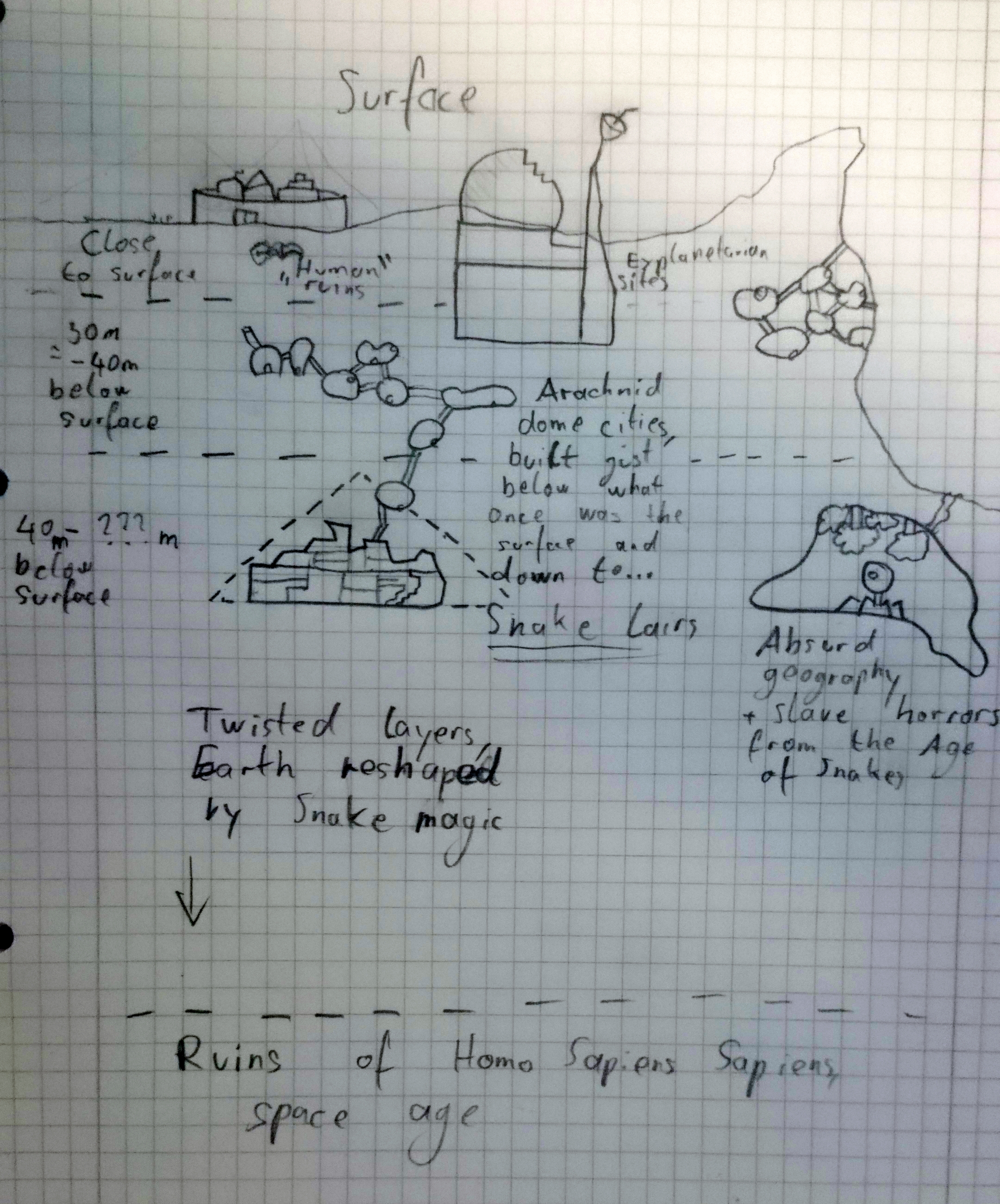
A quick sketch, obviously out of scale, of the arrangement of the most important “archaeological” layers of the highland regions of Gog. (click to enlarge)

Working with the timeline a reverse chronology of the world presents itself in the many layers of rubble. As there is little plant-life present in the highlands of the Magog empire, solid earth is scarce. Dust covers ancient debris, often carried away by the wind, and the stones themselves have been polished by its gnawing tooth. Where in other places many hundred meters of mud would separate the layers, on the highland plains of Magog they lay in close proximity. Digging through the ruins from the surface down to the abyss will go through the following layers of civilization:

  • Surface: Steppe, rocky deserts, meagre grazing lands used by the nomads. Amidst these, roads and walled cities of the Magog. A few construction sites from the time of the explanetarians remain visible, half-buried as they may be.
  • Just below the surface there may lay ruins of the green-skinned Arraqu’s exorcist priests old monasteries, abandoned due the encroaching empire. Destroyed rebel settlements, military buildings and smaller city-states that fell in the 600 years since the establishment of Gog could be excavated.
    This level would contain the main hubs of the few explanetarian sites, where machines may still be intact. The human Magog will find they respond curiously to their touch.
  • In the western part of the highlands, maybe two millennia from today, the civilization of the arachnid race fell in mutual genocide with the explanetarian settlers. Tomb or honey-comb like structures are found about 40 metres below the earth in some regions (or, in some cases and especially alongside the Rift, carved caverns into cliff-sides). Of course most of these would be found in the regions that fell victim to the irradiating star-light weapons of the explanetarians. The oldest explanetarian sites were established somewhat later, but reach down to this layer due to their deep foundations and for fortification reasons.
  • Deeper still, and often serving as the rubble upon which most of the modern world stands today, await the the abandoned pyramids from the Age of Snakes. having served as masters for hundreds of thousand of years, they cover many layers of what was once the surface, and bizarre geography abounds, misshapen by sorcery in war against the planet’s former inhabitants. Many pyramids still stand, desolate and empty – the escaped post-human slave races often dared not return to the cradle of their suffering. Some were plundered by the arachnids, barely able to make full use of the powers at their disposal. A few explanetarian sites – most notably the great “bottomless” pit in the center of the city of Gog, once planned to be a core mining operation – may have found their way into this layer.
  • Twisted layers follow, as the Snakes reshaped Earth to suit their needs. As the former Snake masters withered away, secluded from their brooding worlds, some of their enslaved beast populations and demonic servants may remain in hiding. Everything is possible in that now-entombed world, for the chaotic magic has left its stain.
  • Deeper still, destroyed unfathomably long ago, some remnants of the space-faring age of Homo Sapiens Sapiens may remain to be found.

Gog timeline and map

This is intended to be a vague timeline detailing the important history of the setting of Gog. As to not be forced to write a novel, I will break it down to the basics a gamemaster needs to know for the setting.

  • In the beginning there was nothing, and the nothing was chaos. Eventually out of the possibilities of no-shape-ness, the idea of existence emerged. Thus was born the first order, which gave shape to others. Struggle was between not-being, becoming and being.
  • Ancient times, on a blue world, in the Land of Two Rivers, in a province of what some will call Assyria, a boy is born to a noble house under numinous stars. His name will be remembered as Gog.
  • An age of prosperity is collapsing; a decade-long peace is faltering. Grief comes over all lands, and whole peoples travel to foreign shores to either fight in or escape the ever-present wars. Chaos is rising, threatening to devour the known world. The Gods of Night, directed by primordial dragon-mother Tiamat of the Netherworld, hold sway over human hearts, feasting upon their fears and crimson ambitions. Many Gods of Light succumb, their temples razed and their memory slain.
  • Gog, grown a fighter and leader of his people, takes the throne of the province. In many battles he fights against the People of the Sea and other invaders, yet peace is not won. When need is greatest, wise men in grey robes appear, bearing prophecy. The prince follows the words of a seer, retreating into the desert for the better part of a year.
  • Legend has it he fought a terrible beast upon Mount Lebanon. Others say he spent the whole year in meditation, fasting amidst the sands.
    Whatever the truth: after a year the warrior returns, changed. By his side he carries an enormous black sword called Hope, with a golden radiance following his every step. His banner now shows the head of a great serpent.
  • The tides of war change. Prince Gog secures the borders of his realm, pacifies the region under his dragon banner and spreads the light of the gods of law. After many great battles against men and devils alike, the darkness is driven away, the strength of chaos is in decline. Sanity is regained as the greatest Lords of Chaos lay dying before the combined strength of the Gods of Light and the sword of Hope. The lesser Lords of Change are allowed a continued existence, for Prince Gog demands balance return to the world.
  • The goddess of war and love gives birth to the child of Gog, raising it in hiding.
  • For many years, Gog lives in peace, his throne passed on to his younger brother and seeking nothing but a quiet life far from attention. The veneration granted to him by his people grows with the years, his myth eventually becoming greater than even his mighty deeds. Monuments and temples are built in memory of the legendary hero whose fame surpasses that of all other gods.
  • Among the Gods of Light their rises to prominence a being calling himself the One. His power grows with the years, ever increasing.
  • In the human lands ever more people emerge as prophets of the One god, spreading what they claim his will and burning down monuments to the old gods of chaos and law both. Holy cities and sites of pilgrimage that had survived the great strife before now fall before the holy men.
  • The old gods, magic and the wonders of the world are dying quickly. After mere deacdes, no more are the Abqallu of the oceans, the scorpion-sages guarding the secrets of the desert sands or the stone-warriors of the winged Lord Anzu of the Twisting Winds.
  • The story of him who fought back the demons, who brought peace to the land and smote the people of the sea is becoming more and more adopted and converted into the creation myths of the One. The name of the ancient warrior is fading over the years.
  • Prince Gog, now living in the obscurity of old age and overshadowed by the long-canonized myth of a man he no longer recognizes, is visited my sages in grey robes.
  • An old man is found dead.
  • In a province where the people still cling to the old faith, besieged by followers of the One, a young warrior emerges, with an enormous black sword called Hope and a banner showing the severed head of a dragon.
  • In many battles the warrior single-handedly beats the hosts of the holy men. Winged servant beings of the One fall in great number against him, with accusing calls of “Blood traitor!” thrown at the swordsman.
  • Through his prophets, the One spreads stories of a great foe: one of his most beloved creations who dared rebel against the holy order, defying godly will. All followers are rallied against this foul creature, merely known as “the Enemy”.
  • In the lands still free of the One’s reign the young Warrior, calling himself Gog, shares people around him. As the remaining survivors of the old gods declare their support for him via their priests – the war goddess notably being the last to do so – many soldiers flock to his cause. His loyal men call themselves the Magog. Their new leader brings promise of freedom, yet the battles against the holy hordes cause uncountable deaths. Still, he is crowned King.
  • The battles are a losing cause. As chaos overran the world before, the absolute order and the single purpose of the one now tip the cosmic scale to a new extreme.
  • King Gog performs a secret ritual to conjure Bes, misshapen God of Light and yet notorious trickster among his kind, and Anzu of the Twisting Winds, Bird Lord of Change, but keen admirer of mankind who stayed neutral in previous wars out of disdain for his chaotic masters’ ambitions. In these two, Gog hopes to find familiar hearts. His goal: a destruction of the whole cruel play, to bring an end to all wars by preventing further movement of the scale. Set it in one position, never allowing further shifting again. The three create a plan to enter the world of the grey sages and the ominous keepers of the balance, to steal the very tablets of creation and use their might to shape the dynamics of reality as to never again allow cosmic folly to be in the way of life.
  • With the help of a twisted sorcerer and at a terrible cost, a ritual grants entry to the outer worlds. Little is known of the challenges the three companions faced during their travels. There is a great slaughter amongst the very preservers of the balance, the Palace of Time is raided and its guardian, Fortune, is slain.
  • A man is granted dominion over the prophets, made avatar on earth in the name of the One in exchange for loyalty. His features resemble those of the sorcerer who sent the Three to the outer spheres.
  • Just after defeating the last obstacle before winning the tablets of creation, the Three are ambushed by the winged servant creatures of the One, all hosts of his heavens fighting against the heroes in bloody battle. For days they fight, and eventually Bes is slain. Gog, half-dying and with Hope clutched in a fist hanging limp from is side, is carried back to the world on the wings of Anzu. The heavenly servant beings claim the tablets for their master.
  • Now in possession of the tablets, the One holds unlimited power over reality. His first act is one of vengeance, sending plagues of pests and pestilences over his opponent’s people, flames and burning stones from the heavens, curses and death. His reign seems supreme; for finally his word is law and the world will be cured by his wisdom. Unopposed by the creature he dimly, with only half a thought, remembers as being his father, but grew to believe a rebel servant as by his own story – after all, his word is law and must be law even over himself – there will be perfection. Sanity shall rule. With all the remaining power of the tablets and in a mere second he ruled away all human magic, ruled away all gods of the world, all chaos that allowed such absurdities as gods to exist. The only higher being existence now, he cast himself to his heavenly realm, which he was next to wish away. Now seated in nothingness – an affront to his own logic – he ruled away himself, for the perfect order he brought the world was now set in motion. A perfect world required no god, in fact as the law was his and therefore was complete, any further change to it must prove unjust. That could not be. Already fading away, he smiles, ever proud that he was – and will ever be – the One that healed the world.
  • Shortly before that, amidst the searing flames that fell from the sky, in a crumbling castle and surrounded by the last remnants of his army, King Gog lay dying. And yet he smiled.
    The battle had not been completely lost. In his last moments the dwarf god Bes had struck one of the tablets. During his travels in the outer worlds, King Gog had heard of a place, a realm not unlike that of the grey sages, that existed outside of time. There the scales did not matter; humanity decided their own fate without the mingling of higher – in his opinion, infinitely lower – beings. He could not stop the game. He could not save everybody. But he very well could use what power remained in him, in his god-slaying sword called Hope in his free-willed companion Anzu’s divine heart… and in the shard that had broken off the tablet. With the right kind of sorcery it might just be enough to bring the people who trusted him to that fabled place.
    In the flames and surrounded by screams of dying, the ritual is performed.
  • Later records state that the One god had purged his enemies from the land, turning their whole army to dust with nothing to remain. It was the last of his miracles that was seen, and with that ended his age as the vengeful god.
  • Over the next thousands of years, the idea of the One god and of his law changed. Eventually all that remained were the core ideas of his law, or what his people believed was his law.
    Magic stayed gone, nature behaved orderly.
  • Humanity grows stronger, Rome rose and fell, as did countless other empires. Faiths come and vanish again. Many interpretations of the One arise, with endless troves of people claiming to know his will. Part of humanity aches for divine presence.
  • Technology advances. After countless wars, peace comes to earth. Humanity reaches for the stars and wins dominion over the reaches of space. There is peace with some other species, war with others. Humanity turns out to be stronger, fiercer and more resourceful than most, being regarded with fear and awe in most parts of the galaxy.
  • After many tenthousands of years, one of the planets under mankind’s rule simply vanishes. Then another. And another.
  • Through the singularities at the border of known space, unfathomable objects emerge, planet-sized and defying all logic in their shapes and movements, flickering between being and not-being.  Winged snakelike creatures fly from these through the reaches of space, carried in suspension via means inexplicable.
  • Wars are fought between mankind and these invaders. Where the snakes come, sense stops being an applicable concept. Geography changes, transmutes into living beings, shadows become solid and dreams kill people. Weren’t it as absurd and hadn’t the word long been forgotten, people would this as the return of magic. With combined effort humanity destroys the planet-sized beings, with many allied races sacrificing themselves in the process. Still, most planets have to be abandoned, including the ancient homeworld. Humanity retreats to the furthest edges of the galaxy, rebuilding and rediscovering itself.
  • Without connection to the Mothers the snakes lose some of their power. Space travel becomes almost impossible. Their reality-changing might demands energy, energy derived from the Greater Kings of Chaos that shone so brightly in the skies of their own home dimension. In this plane the only remaining shred of chaos seemed to lie in the ape creatures of the conquered world. Some snakes resort to sacrificing their own kind – for the energy was strong in them, too -, which reduces their number. Others begin breeding the ape creatures, changing and twisting them as well as other creatures of the plane for science, amusement and to increase their innate potential for magic as to gain more power from their ritual usage.
  • For hundreds of thousands of years, chaos rules supreme in most of this dimension’s space. Many different races of ape are bred, each for different purposes, which their bloods and essences tailored to evoke specific magics.
  • The number of the snakes dwindling due to being cut off from their Mothers for many millennia, fugitive ape-creatures from the breeding pits frequently rebel, often killing their former masters who had grown lazy and complacent with old age and unchallenged decadence. Others simply run away, to form communities exclusive to their breed.
  • On most worlds in the outer galaxy, the end of the snakes is initiated by relentless attacks from beings in mechanical suits, slender, somewhat tall and absurdly powerful in their technological prowess. Sadly, their interest barely extends to the former human home world. They don’t seem to value it very much.
  • The creatures – barely recognizable as of (at least mostly) human stock – had not lost their intellect; in fact it was a vital requirement for the purposes of the snakes. In the slave pits they formed their own ideas about the world, kept the power of language alive… and some even managed to catch a glimpse at their former masters’ skills.
  • In the millennia following the decline of the snakes, the new humans re-discovered the creation of tools, of hunting, of agriculture. They formed settlements, city states and cultures – often limited to one of the strictly divergent post-human species, if only for the simple reason of being unable to mate with those of different breeds.
  • Many of the horrors brought forth by the age of snakes remain on the world, often feasting upon the post-humans and using their innate magical power to grow immensely powerful. Sometimes a ship of the mechanical beings arrives and control the population of these creatures. Probes and drones do most of the work, but eventually a fortress with production facilities is installed. A great walled hub encircling a mining operation which drilled down for many kilometres allowed for rich metal harvest to create more battle drones in the system.
  • To the west of a great highland, a race of arachnids created by the snakes  takes up their old masters’ work. Not dependent upon the planet beings for reproduction their numbers swell, their raids into the post-human lands become more frequent. Their sorceries grow potent enough to attract the attention of the explanetarians. The skirmishes escalate to full-blown war. Swaths of land are cleared with the use of nuclear weaponry and anti-matter bombs. The threat is as good as wiped out, except for a few remaining pockets, but the colony suffers irreparable damage, the hulls breached and a particularly terrible summoning attempt of a greater being ending in a complete destruction of the fleet. The remaining explanetarians either flee in escape pods, retreat to stasis chambers in remoter outposts hoping for eventual evacuation – or simply die after a while. Some are able to interbreed with a group of the ape creatures, possessing surprisingly similar genetic coding. Over the course of generations the memory of these groups fades into myth, with some of their artefacts getting plundered and handed down as mighty weapons or seemingly magical wonders.The radioactive wasteland to the west remains testament to the former destructions.
  • The race of green-skinned humans moves mainly to the west, some settling in the forested hills and mountain regions at the highland’s border. There they begin cultivating plants, herding animals and building villages. In time, there’s become the first post-human regions with laws, borders and administration. Stories turn into religions, mystical disciplines arise. The technique of smelting ore is discovered, but far from being perfected.
    Other of the green-skinned race had moved even further west leaving the highland region altogether, traversing the wastelands. In the distant they find great weapon-beasts and fertile grounds at their disposal, but that is another story.
  • The great rift that splits the highland, with one of the few extant jungles densely covering its mighty river, is being settled by the race of blue-skinned giantmen. Some of them possess great mystical power; their society is built around control of such individuals. Still, some use their talents for bringing war and misery upon their brethren.
  • Many other races – foremost among them the umbral herdsmen calling themselves the Njema and stone-skinned former  work-slaves, the Paruti – settle in the central and northern highlands and mountains, living life as hardy nomads or hunter-gatherers.
  • One of the blue-skinned giant race, born with four eyes, becomes a powerful shaman. Looking for power, he summons forth a great horror that threatens to lay waste to the jungle realm of the rift; a hero of his own tribe arises to stop him in merciless battle. The shaman’s foul presence stains the region for decades to come, and many a young man muses of the glory of rulership over the tribes.
  • A post-human race enslaved by the arachnids, bred deep below the earth with translucent flesh and frail bodies for the sole purpose of powerful magical sacrifice, breaks free. Most of them die in the attempt. They seek acceptance in the world, but are considered horrific, chased away from villages they dare enter.
  • Many years pass. Human-like life, while primitive and often ridden with violent conflict, spreads for the first time again. With the exception of few power-hungry individuals barely able to achieve any meaningful results or even make sense of the snake ruins’ secrets, sorcery grows weaker. An ecosystem is established, the chaotic magical transmutations becoming stable facts of the world. Species spread, posthumanity adopts. The green-skinned – after mere hundreds of years after establishing agriculture – become the first human race to write down words and numbers since ancient times. They establish orders of abjurers, priests using mystical power to banish chaotic spawn from their lands.
  • While the world is in relatively stable recovery an army complete with siege weapons, refugee families, wounded and dying, but mostly competent soldiers under the lead of a stern-faced king blinks into existence up in the highlands. The king wields a great black sword, and the army marches under the crimson banner of the dragon. The Magog, but a moment from incineration by the One, awake. They do not awake in the fabled place of KIng Gog’s dreams, but in a mockery of the world as they knew it.
  • Rumour has it an enemy sorcerer had foreseen Gog’s attempts at escape and – knowing of his master the One’s plan to rid the world of magical folly and therefore his own talents – had managed to hide amongst the Magog, quickly stealing away after the tumultuous arrival in this weird world.
  • First contact with the strangely disfigured native inhabitants results in casualties, as communication is impossible. Many think they have gone to hell, facing demons from the old stories.
  • The story that follows is one of near-unstoppable conquest; an advanced civilisation willing and ready to finally create the peace they missed in a previous life – and be it by the blood of all that stood before them.
  • Meanwhile, far to the southeast, many skull-faced slaves of the arachnids have found refuge in the oasis town of Oruula. With their knowledge of cthonian secrets the town quickly rises in influence and power. While still shunned by the general populace of yellow-skinned craftsmen their value is acknowledged by the upper class. They form their own caste in the settlement, serving its trade-lords from a position of secrecy.
  • Friendship between King Gog and trusted Lord Anzu breaks, with the winged Demon Lord flying away towards the high mountains, bitterly disappointed by the outcome of events.
  • The Magog take what they need from the land, but they still need to settle somewhere if they ever want to gain lasting strength in this world. Their pilgrimage brings them to a lake the natives call Hali, where there stands a huge broken metal dome encircling ruined buildings and a bottomless pit. The ruins hide powerful iron beasts, but the few intact ones fall after many battles with the Magog and the terrible black sword of their leader.
    Eventually they settle amidst the metal walls, naming their city after their King Gog.
  • From the city of Gog, Magog rule spreads over the land. Over the decades the fortunes are with them; the walls fill quickly with buildings, barracks, craftshops and temples to what they remember of their fathers’ gods. A palace is erected from the metallic ruins of the ancient builders of the place, devoted to their watchful King. The latter retreats to solitude in the great building, letting satraps rule the city and the claimed provinces in his name.
  • Considering themselves the only humans in this harsh world of sorcerous beasts and demon-like natives, Magog know little mercy. Slavery becomes common. The practice of the green-skinned banishment priests becomes adopted. All attempts at sorcery are forbidden at threat of most severe punishments, with familicide among the kinder options.
  • North of Oruula, in a swampy region where many sources defy the encroaching desert, tribesmen speak of a huge tower from which a powerful wizard rules the land, winged servants doing his bidding.
  • Colonies are established over the course of centuries; Qutta is founded as a quarry town at the northern end of the rift. The great silver bridge over the rift itself becomes settled by the militant priests of the keeper-god for its strategic value as the gateway to the land of Magog. They build the great fortress of Dur-Dannukin to control all traffic.
  • Hundreds of years after the arrival of the Magog, slave revolts in the subdued border regions of the green-skinned race – called Arraqu by the Magog, for their colour – become more common. Gog needs these regions for their rich sources of timber and burnable wood, as without it the manufacture of steel would be  impossible. Brutal punishments befall settlements that refuse to pay tribute, Magog settlers are supplanting and driving away native inhabitants.
    The steel is important, for population grows and the emerging city states of Oruula in the east, the jungle realm of the blue-skinned Gubi giants, the priest-clans of the Arraqu and legends of another green-skinned King’s empire to the far west pose threats to Magog supremacy.

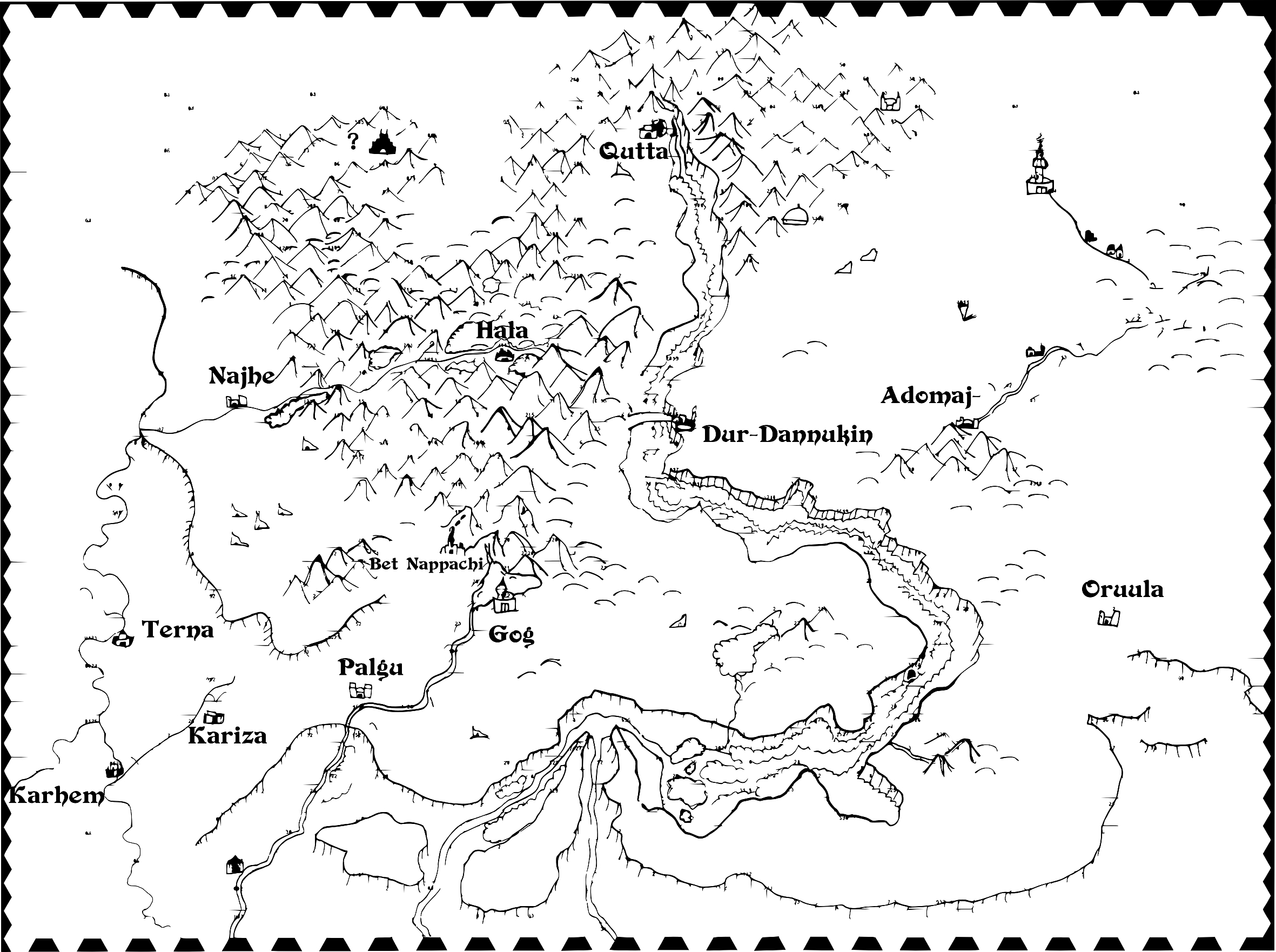
    Annotated map; click to enlarge

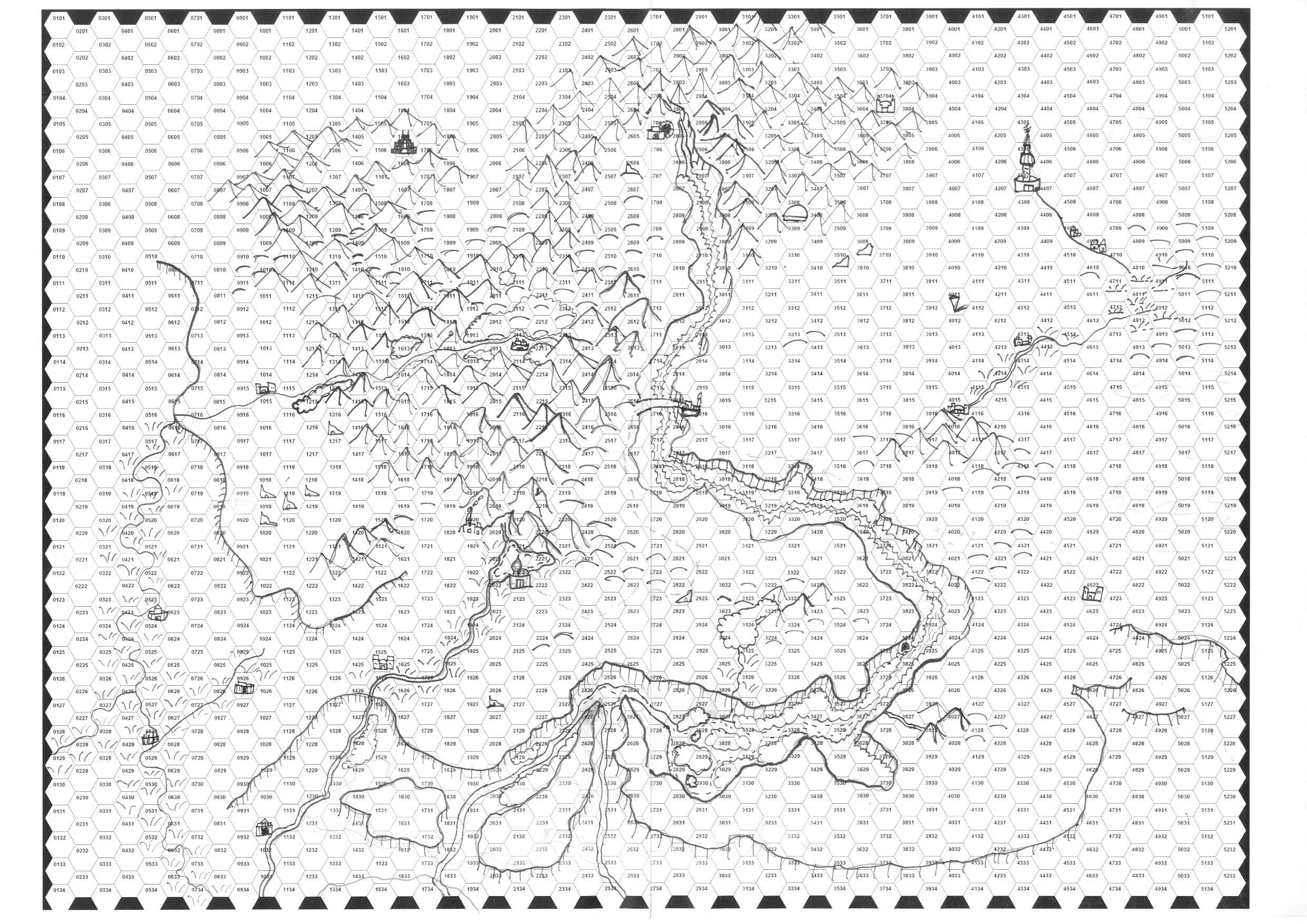
    Annotated map; click to enlarge

  • Dissidence in the realm itself seems to fester. Many young lords and adventurers are at odds with the strict hierarchy. Some make their attempts at open agitation (often meeting a swift end by the sword), others conspire in secret against the seemingly immortal king. Fewer still travel the ruins of old, following the legends of the slave races telling of the sorcery of snakes. There is power to be found beneath sand and stone.
    The temples remain the strongest allies of King Gog, for it is generally agreed upon that the gods and their slowly regrowing power owe their renewed establishment solely to the bearer of Hope. After centuries, priests are able to produce wonders again. With the scales tipped so far to the side of chaos, the One’s ban of magic is not completely undone, but changed. Where all the gods – even those of chaos, for they had name and shape-  once emerged as specks of order in the wild magic of the human soul, their essence now derives some of their power from the ambient magic left behind by the snakes and their alien Mother planets. The effects of this are unknown.
  • In the mountains, Demon Lord Anzu weeps for his former friend. In his eyes, Gog – once the source from which the myth of the One was created – now in turn becomes as the One became before him. Instead of ending the game as they had hoped, the King and his realm merely begin the folly again.
    With heavy heart he sets plans in motion, knowing full well  that his attempts at saving mankind from self-wrought destruction may yet again be doomed.

Karte150

So what do we have? A blasted, twisted land full of more or less primitive to, say, early metal aged human-like subspecies. Ruins of mighty snake people, elusive conclaves of arachnid sorcerers, warring city-states with secret cabals and monastic orders. Mutant creatures of sorcerous origin, or simply malformed due to the devastating radiating weapons from countless wars. Their might be remaining life pods or stations of the explanetarians (who might be what became of the humans that left behind the known stars), sealed away magic that is waiting to be brought back onto the world. Strange extradimensional beings that might be summoned by the foolish or uncaring. Amidst all these a forceful empire of the last remaining hope sapiens sapiens, filled with zeal for their immortal King who might very well be an incarnation of the Eternal Champion – but one who had betrayed the balance he was to fight for, seeking to change the game instead of taking part of it. His curse and punishment might be for him to forever live and see his work undone, being forced to play a role.
We had a god that was created from the myth of his own aging father, a god who became a twisted interpretation of the peace-seeking deeds and struggles of the first war of Prince Gog. A god who later believed his own myth, seeing himself as the father of the rebel hero grown young again.Gog himself, first having fought to bring order to a chaotic world, then to protect the remnants of chaos and change at the threat of absolute law, has become the strongest agent of order again in a mad world. Will he become as the One before him? Why has he retreated?
What are the plans of Anzu, the Lord of Birds and the Twisting Winds? Will he conspire? Will he attempt to bring balance against the law of Gog? Anything might happen.

More importantly, in a world at the brink of collapse, what will the players do? Seek fame and fortune? Fight in the many battles and wars? Search for powerful rituals or ancient weapons from the stars? Maybe create a colony or even found a province of their own rule? Will they side with the Magog (who just might be the only force able to stop the encroaching chaos again) or will they fight its harsh tyranny? Will they attempt to bring magic back, or destroy it for good?
And what about the gods? What are their plans, now that they have sufficient power for existence again?


The Setting of Gog

Gog is many things

A land. A city. A man. A promise to some, a threat to ohters.

Under the burning sun lies crimson Gog. Home to the proud Magog race, built upon cyclopean ruins of forgotten times, named after its founder and legendary king.

It is a big city – perhaps the biggest gracing this forlorn world -, drinking from lake Hali, lifebringer to the deserts and mountains of the great highlands.

Shining metal walls, flawlessly smooth and cold to the touch in hottest summer, encircle towers of red earth and iron that compete for light and the touch of the seven heavens. Gilded temples of all gods bring honour to the city, fierce and strong are her legions.

From his lofty palace in the city’s heart the great king watches unseen, the Šar Ušumgal, immortal ruler of  the dragon banner, undying sentinel and protector since the day the Magog conquered these lands. He had raised them from exile and nothingness, gave them life and lordship over the sub-human peoples of the Paruti, the Gubi, the Ullak, brought sword to the Gullgaea, the Arraqu and Njema. All the world sings his praise, his glory unmatched.

Legend has it he was a lover to Šarrit, goddes of war, love and pain. Kothar-Hasis, the god-smith, and Girra of the Flames bestowed him with the black sword Hope, the death of all his foes.

Abaddun, the prevailing stone, keeps the holy order. In the desert Nergal rules, the mercieless wind, father of Wolf, Hyena, and other mythical beasts.

The land of Gog is truly blessed.

After Gog created civilization, other cities emerged like mushrooms from the ground.  At the source of the cloud-filled Rift that cleaves the highland in twain, where the Rift-river Larr springs from a hundred mountain rivers, industrious Qutta lies. Paruti slaves shed sweat and blood for their red-skinned masters in the marble quarries so as to greaten the glory of the gods with ever new monuments.

In Dur-Dannukin, guardian of the three times a thousand step long bridge over the rift, the Keepers of Abaddun created a fortress of purity and faith.

In the eastern desert Dumaj – blessed with strong sources and natural fountains – wrestles with the horrors of the swamps and the Horned Seer in his tower.

Yet even in Gog, city of clay and iron, shadows spread. The magic of the ancients, of snakes and spiders and the gods before the gods, wakes sleeping perils. Madness lurks in Gog, the madness that threatens to consume the world. In bloody rituals beings are called forth, defying all descriptions; beings for which their would-be masters are but cruel, yet inconsequential parasites, their chains soon to be shed and broken. Still the bulwark of order stands strong, but its wall are being stripped brick by brick.

Yet there is more. The world doesn’t end at the walls of the great cities. Amidst of all the wastelands, the deserts and steppes and mountains, wonders await courageous discovery. Young warriors with iron sword and hatchet of carven stone plunder tombs of forgotten races, metal skeletons of long-dead cities and witnesses of impossible past. Magic lies there, guarded by terrible plagues. A brave man with the necessary skill might find fortune – or an early grave far from home.

Yet not only adventurers venture forth into the unknown. Witchers seek the knowledge of the snakes to hold sway over the creatures of the abyss. What dangers will they bring the people, unknowing or uncaring what it is they’re setting unleashing?

Outside the borders whole peoples break free, questioning the claims and the law of Magog rule. War is in all minds. The lords grow restless, open revolts plague the land. The only answer they can think of: draconic punishments for all agitators and seditionists, for the secret police of the Šar Ušumgal will suffer no treason. But can it cure a malady that has long befallen the whole body?

Gog was many things. A rebellion against a cruel fate. The dream of a traitor, loyal to his people.

A game in the sea of times. A stone on a cruel scale. A borrowed epoch. The saving of one mankind, end to another.

For a thousand years it gleamed. Now the scales are trembling, the sand is trickling away.

Two sides take up arms for the last battle.

As too many times before.

The Herald and the Headsman, part 1

(read on fanfiction.net)

Spring came early this year and the fields were red like poppy. Of course, this was a metaphor. It was too early for poppy to be in full bloom. A lesser poet would describe the field as blood-colored, by merit of the axe-wielding manbeast chopping some lowly serfs to smithereens.

Jonal was a man of refined tastes and sensibilities. There was no symmetry to the slaughter, no elegance to be found in the crude movements of the rampaging brute. Quite pointless, really, but then so was most of his comrades behaviour. If shortening a slew of peasants meant prolonged cooperation, Jonal had to repress his restraint and accept it as a minor inconvenience.

He dodged a running goat, fleeing from an enclosure that had been shattered by the Headsman’s blows. The animal came bah-ing at him, nearly soiling his long red overcoat with mud. He read in it a mixture of confusion, fear and joy. Amusing, wasn’t it? There they were, forcing their way through this mudhole of a village for no reason but his companion’s satisfaction. And while there were some unfortunate incidents, some good had come out of it. The little beast was now free to roam the majestic wilderness, no doubt happy to be spared the kettle of some dirtfarmer’s wife. From a certain angle, Headsman’s work actually had an artistic ring to it, bringing an equilibrium, like his own private of rebellion. Overturn the tyrants who had so cruelly locked away the lesser creatures. Jonal smiled. Why, yes, the delay suddenly grew that much more enjoyable – another crash, followed by some deranged scream  too high for a woman even. Headsman had just spoiled Jonal’s romantic rendering of the scene by some senseless splitting of another goat. Ram? Doe? Jonal couldn’t really tell, as he had never particularly cared about animals that still had fur on them.

He sighed. Time to bring an end to this. He put one hand at his hip, the other to his mouth as a make-shift  megaphone. It was not necessary, as his voice wouldn’t need to be heard to be _heard_, but some dramatic gesture underlining the conveyed emotion was simply pleasing.

“Hey, big one!” Hands remaining in their place he leaned forward, stood on one leg and bent the other one up behind his back like a scorpion’s tail. “Would you kindly lay down the manslaughter and hurry on?”

There was silence. The few stubborn farmers who had decided to fight the threat off dropped to the ground, their hands pressed against their ears. A brown bird fell to the ground a pace to Jonal’s left. Embarrassing. “I am deeply sorry, good people. Heartbroken, really.” One of them tried to get up, one hand about to reach for a cudgel. Jonal harrumphed and the man fell to the side, sodding. “It is quite impolite to listen in, though.” He turned to the Headsman. Unlike the others, the giant had not fallen. Even now, on his knees, he must have been six feet tall. The dull eyes on his unmoving silver face set on Jonal. Headsman did not speak; he never had, as far as Jonal could tell. Nor did he hear anything with those shiny metal ears of his, or he would have lain in the ground between his playthings. Jonal focused some more, this time directing his power directly at the giant. “Come, my friend, you had your time. There will be more exciting prey for you where we’re going.” The Headsman rose to his full size, now well above seven feet. Despite the massive bulk – he was almost two feet taller than the admittedly scrawny Jonal – he was elegant in his movements. Jonal watched his own reflection in the shifting body parts. It did not look like a motion orchestrated by the interplay of joint and muscle; instead there was a similarity to the octopus’s tentacle or the winding of a snake, with the interlocking bone structures being mere make-believe props. Jonal had suspicions regarding his comrade’s actual way of movement, but decided to dwell on it at a later point. Headsman had picked up his axe and strode towards him. Without further ado, Jonal the Herald pushed back a lock of oily black hair and turned around, his long coat swinging as if carried by a gust of wind. A step, a jump and on he lunged towards the monastery.

“It’s about time we visited some old friends, don’t you think?”

… if only to have the company of somebody interesting, he added in his thoughts. Somebody who could hold up the other end of a conversation. But no need to rub it in the silver man’s face. There is no point in being cruel, after all. He was an artist, not a ruffian.

Cinder 1.1

They had been tracking him for five days straight, passing a good dozen of hamlets and thorps reduced to cinders, a trail of ash covering the snowy plains inbetween. The stories they heard were hard to believe. Survivors spoke of a man who came in the night, stark naked, who moved through the shadows and screamed like the thunder. What he touched was burned to the ground, the flames flickering into the nightskies, yet sparing the man who brought them over the plainsmen. Men and women were burned in their homes, livestock grilled in their stables. The few who dared stand against the man saw themselves burst aflame.

Hard to believe, Sarn ruminated, but then, so was the destruction that lay before him. Worse than most he’d had to stomach in the two since joining the company. He could not see many details in the dark of the evening, too early for the stars to show. What he did see was enough to tell that there would be no survivors in this village. As he returned to the other riders, guiding his horse by the leash past the rubble of what might have been a barn only a few days ago. He could still smell the roast flesh of pigs, mixed with other smells he didn’t want to think about.

Another pair of riders who happened to return at the same time seemed less hesitant, having helped themselves to a large cut of meat that had been first cooked and then preserved by the biting cold of the winter winds. It left Sarn uncomfortable, but he could see their reasoning. Better take from the dead than from the living. Besides, this mission already took longer than expected. Their prey moved too fast for a man never seen with a mount, too fast for the kneedeep snow covering the ground.

“… bastard even torched the orchard by the river”, he heard someone say as he was welcomed with the traditional greeting – a strike to the chest by his comrades. The speaker turned out to be Fish, their best marksman and the warrior of greatest seniority and seniority. The name was ancient, with everybody agreeing on the bulky man’s bulging eyes being the reason. Like every archer he had massive shoulders, making him look more like a manta ray than anything else. He continued: “Rode on to the hill, saw smoke and flame about three miles from here down south. Wind’s in our back, so we didn’t see it earlier. Bastard’s passed there just now, might even still be there. S’ppose we get lucky today.” Fish absently put one hand on the longbow that hung at his horse’s flank. While he grinned, the others looked less enthusiastic. Nobody was eager to face the man who allegedly destroyed almost fifteen villages single-handedly.

Sarn could understand their fears. He did not buy that the man was acting solitarily. More likely, the arsonist was assisted by a number of archers with flame-dipped arrows or bandits carrying concealed torches. He was good with numbers, and going by the speed with which the flames had spread through the villages Sarn figured there must have been about twenty helpers. It fit with the attack always happening at night. Have one man take the leading role, grab the attention, and have the other infiltrators approach with dark clothing. While everybody stares at the naked madman the roofs are set aflame. Since he was also a pessimist, he made that thirty attackers instead. Thirty robbers against his thirteen riders. Not good odds, but also not catastrophic. They had faced worse. Yet, there was one thing that bugged him. Robbers tended to, well, rob. But in these villages nothing was stolen. There was nothing to get there, anyway, but not even the granaries or the stables had been looted. Everything burned that was fixed to the ground, nothing taken of what remained. He had seen coinage and even a silver spoon in one ruined home, untouched. It didn’t make sense. Was it to spread fear? But who would gain something out of it? Did the bandits want to establish a territory where they would not be disturbed, scaring off all possible intruders? He scratched that thought. They must know that such a killing spree would not go unanswered. His lordship does not tolerate insurgents.Very strange indeed.

With a frown he turned back to the conversation, facing Fish. “I know you are in charge here,” – a nod of ackowledgement – “but as second in command I suggest we split in two groups. One charges visibly, the other approaches from behind. If he has archers – and I think he does -, a full charge would be suicide. I say Lonn and Kaidn do the frontal approach, distract the attackers.” He pointed at two riders equipped with lances, javelins and large wooden shields. “Lonn, you take the horn. We split a mile away from the village. You two ride towards it half an hour after we split, torch ablaze. Make yourself seen. As soon as you get attacked, sound the horn, use those shields and retreat. We know they are distracted and fall in their back, pluck them from their hiding spots. Half an hour should be enough time to find them.” Sarn smiled, satisfied with himself.

Fish glanced at him, head cocked to the side. “Well, boy, sounds good told in a nice story like that. Makes it sound easy. Thing is, I didn’t get to lead this pack because I made nice easy plans. I broke the lance when you were still sucking at your mother’s breasts, boy! Too easy. Say, what happens when they get the shot before they grab the horn? Enemy archers not even seen yet, you just assume the two fools will react in time.” “They got shields, they just ride in with them raised!” “Right boy, and in the other hand they have the torch and then Kaidn will grow a third one for the horn. Good thing they can hold the reins with their buckteeth, huh?” The two riders were looking even less pleased now than when Sarn had explained his plan. Before he could make an inappropriate remark he reminded himself of his rank, exhaled, and said: “Still, Breaksword Fish, I stand by my plan. I know that there are certain ri-” “Oh, I never said it is a bad plan, boy. Just that it was too easy. Yes, there likely are archers. The distraction and the call are good, too. But if you ever want to lead a fist of riders, make sure you know the weak points of your plan and explain them to the poor sobs who do the work. Look the two in the eyes. You just gave them the most dangerous role in this play. When you lead, you don’t get to tell nice stories. You don’t get to do that, you understand? Tell them what they might face. I know you’re smart, boy. I’m fat, yeah, and I’m getting old, meaning I was to too good to die when I was young. Don’t be smart. As a leader, you got to think yourself as stupid as that ugly mule you call your horse. Doubt everything you plan.” By now, even in the dark one could see the warriors roll their eyes. Sarn’s muscles were tense, his head tilted downwards, his jaw clenched. He hated Fish’s lectures. The fool was so full of himself. Still, he managed a mumbled “Yes, sir.” “What did you just say, Rider Sarn from Aldirk? Look me in the eyes when you speak!” “Yes, sir!” Sarn managed to put enough poison in the title to make a bull drop dead on the spot. Fish seemed to ignore it. “Very well, then. We do as you suggested. Good plan, well done.”

It took them a while to move around the hill. The horses dealt badly with the cold and the deep snow slowed them down significantly. It did not help that by now the stars and the moon were shining brightly. They had covered every piece of metal on their bodies in heavy woollen cloaks, in order to prevent any reflections of the fires raising into the nightsky a mile and a half in front of them. Screams could be heard over the distance, despite the wind taking the sound in the opposite direction. Wind in the back was a good omen. It was not much, but going up against an unknown opponent shrouded by rumours? They took whatever they got.

After crossing a frozen brook, they decided to split. Lonn and Kaidn were handed one of the fist’s horns and waited beneath some rocks. Fish pierced a fine hole in the neck of a leather flask and hung it in a shrub. “When it stops dripping or it freezes, you begin riding. Half a mile away, light your torches. There’s an attack on you, you sound the horn. Got it?” Nods from the two riders. With that sorted out, the main group of eleven mounted men followed the curve of the brook that looks like it led past the village in some distance. They did not hurry, for every clanking of the equipment might give them away to archers in hiding.

Their was surprisingly little shrubbery around. Fish sent out individual scouts to search for hidden archers the next 100 steps or so, then return. The first six times, they – as expected- returned with nothing  to report. No shrubs, no big trees, no outcroppings, nor any other viable cover. They might have moved on, Sarn thought. At least there had been now flaming arrows in the sky since they began their approach. Only the flames licking at the clouds, flickering in the wind. The sounds of dying livestock, some human screams mixed with the thunder of falling roofs and walls. A few hundred yards to his left, Sarn could see the blades of a windmill go up in fire.

Shortly after they sent out the seventh scout in a row, having made their way through half the distance, they heard the noise of footsteps and hectic breathing. A woman waded through the snow, wearing heavy snow boots under what looked like a rough night gown. Dragged by her hand was a young child, perhaps of seven or eight summers, that was blanketed in cloth. Sarn could not even tell its gender. Both of them were covered in ash, coughing from time to time. When Sarn pulled down his hood to speak to them, the woman screamed in surprise. Right – in the dark, she must have not seen the riders, with them and their horses being covered by dark cloaks and rugs. He cursed under his breath in expectation of another public “lesson” courtesy of Fish. For now, he hushed the woman.

“Be quiet! We’re here to help!” Fish approached. “What’s your name, woman?” His tone was severe. Sarn frowned. Did he want to scare her even more? “Biri, your lordship! Please, you must help my Bronor and t-” “Did you not listen to my man, Biri? Be quiet!” She swallowed, pressing her child against her body. The small one whimpered in a high voice. “Now Biri, you do as I say, understand? First, you hurt? No? The small one? Good, one worry less. Can you tell me what happened?” Still holding the kid tightly, she spoke after a moment’s hesitation. “We were looking for Bula, your lordship, me and my Wenn here.” She pressed the child’s hand. Noticing the impatient look on Fish’s face, she continued. “Bula’s our cow, your lordship. She was about to calf, you see. I heard her go moo and thought that, ahm, that it was her time, so I ran and got my Wenn here to help. It’s why I only got my night shirt, you see, and I am sorry for the immodesty, my lordship, but when a cow needs to calf you don’t have time to ch – I’m sorry. So we got out and saw the smithy house burning! Had happened before, so I looked to help. But then the other house started burning, too, and then the next one and people screamed!”
“Did you see any arrows above? Men with torches?”
“No, your lordship, no arrows. But no time to look in the sky either, for there was this man in the middle of it all, just in the middle of the road, leaning to a barrel that rolled over there.”
“What did he look like? Any weapons?”
“He was all naked, but I am not shy and I thought, Biri,he must have fled straight out of bed. The poor man must have been freezing, so I take off my gloves, want to give him at least something. He was mumbling something and when I got near he screamed at me, just shouted how cold he was! So I said, of course you are, you’re naked and gave him my gloves. He tore them from my hands, his fingers cold, didn’t even say thank you, but just then the barrel must have got a spark and started to burn, too, and he screamed ever more and that is when we two ran off. But now please, your lordship, please help my Bronor and the others!”

Fish gave her an odd look – as he always did with those bulging eyes of his that just looked too big for his face -, then gave a nod to the others. “Men, we continue as planned. Rori, you give the woman your coat and bedroll. I know about the pork you got earlier, now’s your time to give something. Biri, you go hide somewhere safe from the wind, alright? Find a few rocks, cover yourself with the coat. Everything will be fine.” Obviously, everything wouldn’t, but for now it would suffice to give her hope.  The way she had been rambling she was under shock. The last thing they needed right now was to keep eyes on a shocked peasant. They sent her away from the village and continued to circle it. Sarn studied Fish’s face. Was there a hint of fear in it?

Before they reached the backside of the village, they encountered nine other fleeing people. All of them told roughly the same story – suddenly, building after building started burning. About half of them mentioned the naked man, some describing him as crying, some as screaming. One said he was robbing the dead, another said that he grabbed people and threw them into the fires. All of them had been caught by surprise, carrying only what they happened to find in the few seconds or minutes they had before they were forced to run. Sarn didn’t like the thought, but he was pretty certain that none of them would survive through this winter. The closest villages had either been hit in the same way or already had to feed the firebringer’s refugees on top of their own people. Nobody would take in any more strangers, not with a madman out there who some thought to be a demon from the deepest pits.

As if to give more weight to that last thought, the wind intensified and brought a hot cloud of smoke and stench over the approaching riders. It burned in their eyes even with hands and hoods shielding their faces. They had been unsuccessful in their search for archers further away from the village. According to Fish, the described lack of arrows in the sky and of hidden archers meant there must be infiltrators inside the village.

All they could do now was wait for Lonn and Kaidn to light their torches and do the distraction. Of the village, almost nothing remained untouched at this point. A stray thought crossed his mind – were fires supposed to burn this fast? It struck him as odd.
The air was heavy with the smell of burnt flesh and hair, ash and sparks being carried away. A solitary wooden beam would stand a little longer, only to come crashing down to mock the remaining hope. It was hard to tell moving shapes from dead objects when watching through and blinded by the flickering flames, but Sarn was sure that of what might have been a community of a hundred people only a handful were left, stuck beneath tumbled roofs. There were almost no more screams to be heard. Some of the men had been eager to help, but Fish had held them back. He stuck with a plan, once made, even if it meant sacrificing peasants.

Almost no more screams – except for one. One voice was audible through the night, coming from directly beyond the highest tongues of flame, screaming in a pitch too high to be human. It was a man’s voice, but twisted in a way that reminded Sarn of grinding teeth. Eery.

In the distance, slightly uphill beyond the village, they could see the torches of the two chargers light up, approaching quickly. “Now?”, Sarn asked Fish. “No, boy, we wait. There might be no archers here, but we still got to make sure our brothers got the bastards’ attention. No point in sacrificing one half of the plan only because the other didn’t work out. You see, when we were fighting the Hulthra-Clan over in.. ” Just as Sarn dreaded another lesson, the horn was sounded. It was hard to tell anything, but the torches stopped coming closer. Again, the horn. “Men, charge now! We storm that hellhole and hang their hands from our belts. Let’s go!”, Fish urged on. They all kicked the flanks of their horses and began a fast approach.

The drone of the horn stopped, only its echo continuing for a moment. Then, it was replaced by a deep sound that quickly swelled and rose to a higher pitch. It was hard to tell, at first, but Sarn realized it was screaming. Wailing, sounds of pain, coming from man and mount. There is no sound quite like a dying horse, unmistakeable. The two torchlights flickered up, blazed bright like the sun for a moment, then there was nothing but flame in the distance where Lonn and Kaidn had approached. And then nothing.

What had happened over there? No flaming arrows. Still some hundred yards away from the village. No way anybody had got to them that fast. Just as they reached the outskirts of the village, the male screaming returned for a moment. He hadn’t even noticed it was gone. With his eyes adapting to the brightness of the houses burning around him in a wide circle, Sarn rode his horse down the solitary path through the village. In front of him, standing next to a burning tree there was a man. Naked and tall, almost lanky, not a single hair on his body. He stood bent over, his arms wrapped around his body in a tight embrace. As Sarn rode closer he could see that the man’s posture was crooked, one leg bending at the knee in a painful angle. It looked broken and was dark with bruising and bloody crusts from a row of deep cuts and crushes. The man’s skin was pale and of a blue-ish tint, with his toes and fingertips almost dark blue. His genitals were shrunken and almost grey in colour.

The whole group encircled the man, riding around him like sharks around their prey. Nobody attacked him outright, with everybody looking out for more bandits hidden behind some ruin. All their attention was caught when the man started rocking back and forth, mumbling something, then almost spasmed, snapped his face up, stared straight through them with bloodshot eyes. His back to the burning tree, he shouted: “I AM COLD! WHY IS IT SO COLD? HELP ME! HELP ME, PLEASE!” He reached onto the tree, which in turn burst into ever brighter flames, the heat unbearable for the nearby horses who reared away in shock. Three send their riders crashing to the ground, covered by the rugs falling from their backs.Others backed away noticeably, with only five riders keeping control or their mounts. Sarn, Fish and three of the others. The blaze was so hot that Sarn had to look away and cover his eyes, but the last thing he saw was the naked man embracing the tree, throwing himself against it while sobbing madly. The heat grew stronger, smoke filling his longs – and suddenly there were screams all around. He could hear Fish shout something, but was to busy keeping his steed from running off to listen. She moved back and forth, then trampled over something soft. When Sarn looked, he saw it was one of his fallen comrades, crawling away from a burning coat that lay behind him. He could see the man’s leg had been broken by the hooves. He could worry later. More pressing was the naked man frantically tearing at another fallen rider’s cloak. He pulled it from the man, but as soon as his fingers touched the leather it started burning, already reduced to ash before the man was done putting it on. Another frustrated scream, another cry for help. The tree was completely gone by now. What in all hells’ name was happening here?

The riders who were still on their horses retreated as good as possible. Fish especially was kicking his stallion hard, hurrying a fair distance away. Was he fleeing?
There was no time to help their fallen brothers. Get out the javelins and pierce the bastard. Sarn managed to control his horse, turned towards the demon-man again, spearpoint extended towards him. With a kick he rode by the man, prepared, aimed for his back and stung.

Except there was no sting. Where the man had just been cowering of a fallen man, gripping his victim by the hair, there was now only a man rolling in the snow with a red, scarred scalp trying to extinguish the fire on his head and his shirt. The smoke of burned hair stung in the nose. Instead, there was a scream followed by a snapping sound far to the right hand side of Sarn. Dismounted, Fish stood next to his black stallion, one hand holding his mighty longbow. Well, part of it – the wood was burning. The naked man had a tight grip on Fish’s gloves and bow, incinerating them all. An arrow stuck in the ground a couple feet away. Fish tried to wrestle himself away from the man, but his burning gloves stuck to his flesh.Charging towards him, Sarn hadn’t much time to think how the man had crossed dozens of yards in the blink of an eye. All he could see was his leader kicking the attacker in the chest, sending him back flying. In the same moment, though, Fish’s boot turned black and smouldered. The man spasmed on the ground, throwing himself around on the snow as if the very touch hurt him like the cut of a knife wailing and crying: “WHY DON’T YOU HELP ME? YOUR CLOTHES! I AM SO COLD! OH GODS PLEASE HELP ME MAKE IT STOP! ICE IN MY VEINS, ICE IN MY EYES IT IS BURNING COLD MY LEG OH GODS MY LEG HAVE MERCY MY LEG SO COLD!

Fish crept backwards, pulling at the smoking gloves with a pained expression, his teeth showing. When he finally got them off, his eyes went wide with terror.

Meanwhile, Sarn had arrived close enough to be in his spear’s reach. The naked man crept towards Fish’s gloves, reached for them and burned them in his hands, crying ever louder. Before Sarn could ract the man disappeared again, with his whimpering suddenly coming from the left where he lay on a fallen wooden sign next to a blackened corpse. Again, it started burning immediately. This time Sarn had enough clarity to throw his spear, hitting the man in his good leg’s thigh. The wailing stopped for a moment, with the man just staring at the shaft. Sarn looked to the leader of his fist. “Fish, you alright?” “Piss off, boy, just kill the bastard!” He took it as a yes, quickly threw down his horse’s woollen cover to Fish so he could extinguish any remaining embers on his clothing.

An angry sound. The man was on his knees, started to snarl at him, eyes wide, teeth showing, arms stretched forward. The spear shaft burned to ash in a mere blink. It looked like the man would leap, despite two grievously injured legs, but then he was gone.

Sarn’s steed neighed in fear as something shifted her weight. “Look out, kid!”, he heard Fish shout. He immediately let go of the reins, got at least one food free of the stirrup and then jumped away to the side. He was still stuck in the right food’s stirrup, one leg bound to the horse’s flank as it trampled around, overwhelmed by the situation. It shook and pulled at him, but at least he wasn’t being roasted alive. Evading hooves crushing down on the ground he could see the naked man spread over the horse’s back, bleeding from the leg, who tried to grip the reins, lighting them up in an instant.

The horse wasn’t burning. The tips of the mane were starting to smoke, but it was nothing compared to the tree-turned-furnace he had seen before. When the smoke got worse and he could see the flame on the reins touch the steed’s head, he realized what was going to happen next. Just in time, he managed to get his other foot free before the horse ran off screaming, taking with it his saddlepacks and his spears. His shoe fell down on the ground, but that was a small prize to pay. A death by dragging would not do well for his career.

Across from him the man had fallen down, looking at him and holding his legs in pain. “YOU! WHY DO YOU HURT ME? WHY DO YOU HURT ME SO MUCH?“, he screamed almost inaudibly high. The man crept towards him. He would have only seconds. Less if the man just “jumped” again. What had he just seen?

The horse didn’t burn. The reins burned. What else?

The man crawled closer, maybe four full steps away. The metal of the spear tip was glowing hot inside the wound, yet there was no smoke coming out from it. What else?

Behind him, Fish was whimpering in pain. What was the old fool doing?

Fish. Burned gloves. Sarn tried to stand, but just fell down again. Apparently his ankle was broken from the stirrup stunt. He hadn’t even noticed the pain. He rolled a couple inches away. What else?

Gloves. Something with gloves. The woman gave the man gloves. What did she say?

The man crawled closer. When he waved his arm, trying to grip Sarn’s fallen shoe, the young Lancer laughed. “Cold fingers.”

As the man grabbed the shoe and held it to his chest, burning it, Sarn began to unbotton his shirt and threw it on the ground a couple feet next them, pointing at it. “Hey beanstalk, you’re cold? Have my shirt!” “COLD! IT HURTS! MAKE IT STOP!“, the man screamed in his general direction as he appeared directly next to the shirt, all but throwing himself on top of it.

While it smoked he removed his pant, his belt and his remaining shoe. As soon as he reached the underpants, Fish started to laugh loud, almost maniacally. Did he understand? He threw his clothes in different spots just next to the man on the ground, keeping only the little knife on his side. “Look at that, Cinders, more stuff to keep you warm!” The shirt was already gone. By the time the man had reached Sarn’s pants and started to consume them with his fire, Sarn himself was just as naked. The snow was freezing his toes, but he did not care. All he saw was the other man rolling on his burning pants, savouring what little heat emerged from the small fire.

Still unable to stand properly, he moved forwards in a crouch, knife raised. When the man caught a glance at him, it was too late. He hacked deep into his enemy’s pale flank, sending a stream of blood into the snow. The man’s skin was cold where he touched it, gripping him by the ankle to prevent a counter. Sarn stabbed again. “STOP IT! STOP IT PLEASE! IT IS SO COLD! MY LEG! DOESN’T ANYONE HEAR ME?” He didn’t care when the man put a hand on his head, didn’t care when he could smell his own hair burning and smoking. What mattered was that his hand could touch the man and was not burned. Another stab, this time almost getting the taller man by the neck. They wrestled. Sarn’s chest hair was burned away, as was his beard. It didn’t matter. His opponent’s movements were getting slower. One more and it would be done. Just one more stab and – and he was gone? Sarn blinked. A scream from behind. He turned to see Fish, his upper body undressed, with the man sitting on his still-clothed legs. Right. There was nothing more to burn without his clothes and hair, moved on to the next source. Had to?

Fish yelled something inarticulate as the trouser started to burn. “Keep him busy, Fish. Feed him!” Sarn limped closer while Fish rolled around, trying to delay the consumption of his remaining clothing. He could smell cooked flesh and smoking fat. Had Fish heard him or had his own screams been too loud? Just two more steps. The naked man was sprawled all over Fish now, with smoke coming from his leader’s back and scalp. The pants were gone. Two more steps and he could plant in the knife in the bastard’s back.

He turned to the side, away from the two wrestling men. Fish yelled for help.

Three steps away from the two. More screaming, more stench. Sarn got ready.

There was a slight breeze. One stab. Heat. Two more stabs for good measure. He let go of the knife.

Almost hidden by the snow was the cover of Sarn’s horse that he had dropped for Fish after he was attacked first. On top of it laid a man’s corpse, bleeding from a wound in the neck, knife still inside, his arms in a close embrace around his body. Blood tinted the dark wool in a glossy red. Some smoke came from below the body, but nothing burned anymore.

A cough behind Sarn.

“Fuck me thrice”, Fish said.

It was done.