The second part of the module, following the description of the lower ruins, settlement and background of the ancient Juggooli citadel of Jogovar.
The whole inner perimeter of the fortress ruin, gaining height towards the center, is covered by reddish sandstone rubble, broken clay bricks and thorn bushes; sand is filling the crevices. A few corroded and twisted metal pieces lay spread among the debris.
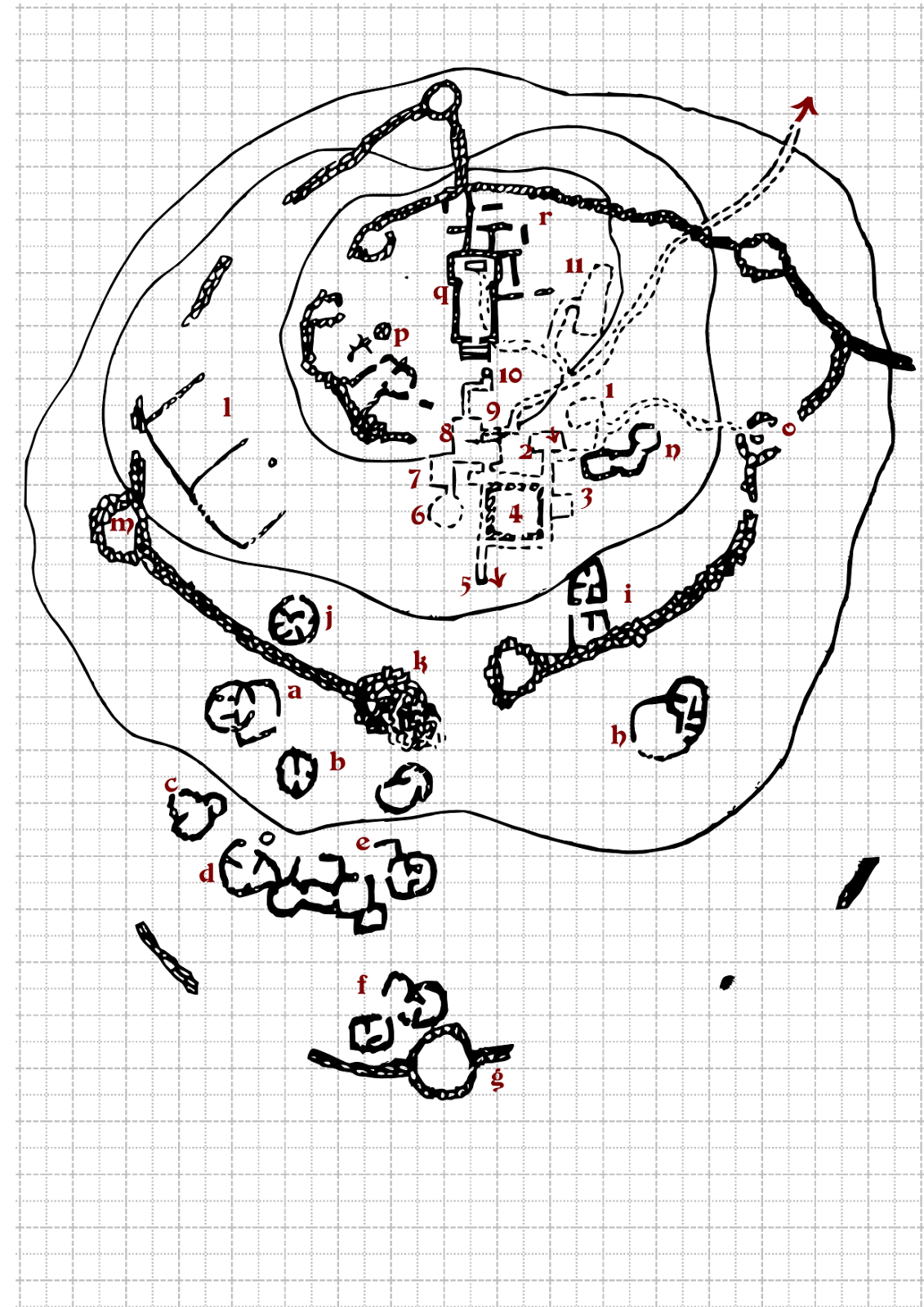
A map of the area; one field equals six metres. Dashed areas below ground. Click to enlarge.
u) Two seemingly well-preserved buildings. The northern one is built directly into the incline of the mound. The domed ceiling is still present, but at threat of collapsing. If there are strong vibrations or if heavy ground work is performed (like digging for treasures, moving stones) saving throws or whatever is appropriate in your system may be necessary to prevent being crushed by falling stones. The building has been looted long ago.
j) The ruined walls of this domestic building hold nothing special.A little digging through the rammed clay floor reveals a thick corked ceramic vessel, containing the well-preserved skeleton of an infant. The vessel is covered in glowing imperishable writing. In the dead tongue of Juggool the makers plead for acceptance of the stillborn child into the arms of a Great Mother Goo-Lehe where it may speak well on behalf of the living. Together with the skeleton some pearls and a small but valuable ruby are buried in the vase.
k) Completely destroyed tower ruin that serves as a quarry for the settlers. Among the rubble there is a knife of polished flint with a grip of blue metal, apparently cast around it. It does double damage against Arraqu and all reptiles. It was created by the Juggooli as a weapon against the Lords of the Glass Lands, an empire still existing to this day. As they are of the same species as the local Arraqu people of today, the knife holds equal power against them. Should the knife be carried into the Glass Lands and its origin revealed there will be grave repercussions for the user.
A poisonous snake, moderately dangerous, made its nest in the ruin and dislikes disturbances.
l) Large, but barely recognizable angular foundations and a well. Maybe used as small gardens or orchards for the citadel’s occupants? Perhaps a former corral? Or something else entirely?
m) Almost completely preserved tower ruin. Still high enough (say, 14 metres) to allow overseeing the surrounding terrain for many miles. Access via the inside of the mural ring through an archway. A stone stairwell leads to the tower ceiling that is often used by Juthul (see building a ) as a viewing platform – both to look out for invaders and to find solitude in disheartened bird watching. In fact, an air of melancholy and despair befalls all characters who linger around this building – an echo of the ancient siege. The place is exceedingly well suited for the summoning of ghosts and for other breeches relating to time or the transition between states of existence.
n) Around a small ring of stones – once a makeshift fireplace – lay the gnawed and de-marrowed bones of three humans. Going by their shape, sage of anatomy may identify them as former Magog, Ullaki or Arraqu people. If specifically inquiring about the shape of the skull the Arraqu may be ruled out. Cause of death in the corpses is not obvious, but one of them misses the left forearm.
Nearby are a couple of broken clay tablets which may be pieced together. They are personal notes speaking of stairs to many tunnels beneath an altar. Another tablet is a contract between a client offering a sizeable reward for the procuring of a certain object, legally verified by a notary from Dumaj. The object seems to be some kind of remedy or drug called “the Uptar paste”. A small expedition was to be established to this end.
The contract contains the names of four men, undoubtedly of Magog language – so either true Magog, freed slaves or culturally assimilated outsiders. It dates back twelve years.
The building contains not much else. The remains have long been stripped of all valuables by the settlers.
o) The middle of this crumbling tower ruin with walls preserved to hip-height is free of the otherwise ever-present thorny bushes. The reason for this is a trap door made of heavy stone, buried roughly at forearm’s length beyond the clay crust. A knowledgeable character might figure out that a lack of vegetation often points to obstacles preventing the growth of deep roots for water-dependent plants or to dry hollow spaces beyond ground. The trap door is opened upwards and reveals a four metre deep stair. More for this will follow with the description of underground area 11.
p) Defiled marble monument. Shows a god or hero of the Juggool. The face has been shattered from the eyes downwards. An arm is lacking; it is being used as building material in Gruula’s hut (see building b). What remains of the statue is a soft, slightly abstract style that poses a sharp contrast to the rough-hewn stone blocks and clay bricks of the ruin.
Further destruction of the statue brings cursed dreams upon the offender, eventually leading to mental maladies. Gruula may be a victim of this, growing more unstable.
q) Two metres of stair lead to this building. It used to be a walled platform wtih a big altar; some sort of temple that blends into the wall ruins to the north and west. It was once part of one great complex from which the citadel was led and administered. The alter, a rough block of green-hued marble, can be moved by the combined strength of four men. The former rotation mechanism at its side is all but rusted away and completely stuck. If the alter is pushed towards to the wall, explorers will find a stairway leading downwards.
The walls of the building are mostly ruined and smashed. Some stones still show the fine glowing writing of the Juggool, but any attempt at piecing them together is likely futile.
r) This area is badly damaged, worse than most. Only the little area bordering at building q and connected to the ring wall still has a little domed roof, supported by a stone pillar, and may be entered from the north. The floor is dug deep here, down to the level it used to have before the citadel’s destruction. This is thanks to a male giant electric hunter roach that built its nest here. It avoids the settlement to the south and rather catches grazing solitary goats or game. Its digging uncovered trinkets worth 100 shekel, including small battered silver rings strung up a wire into two chains. Each chain contains five rings with one engraved letter that may be Juggool or something else entirely.
Below an assortment of secretion the excavated walls show traces of glowing paintings of a very abstract style, portraying a gift-bearing procession of long and slender black-skinned people with elongated skulls. They march towards a great fortress on a hill. The opposite wall shows similar people in battle with great beasts and green-skinned riders. The black-skinned fighters carry rods from which blue and red flames pours forth. Winding and curved letters in the Juggool tongue seem to describe the happenings.
The enemy soldiers are the Lords of the Glass Lands in the far west, green-skinned and shaped like the Arraqu people. A war was fought between the Juggool people and the western riders once; the two people used to be hereditary enemies vying for control over a trade route along the western highland before the appearance of the Magog brought an end to the witcher-kingdom of Juggool. If traces of history are glanced from the writing in some way (per ghost summoning, erudite study or other means), the location of 1d4 former battlefields or contested trade towns will be revealed to explorers – potentially leading to loot or strategic resources that lay forgotten.